
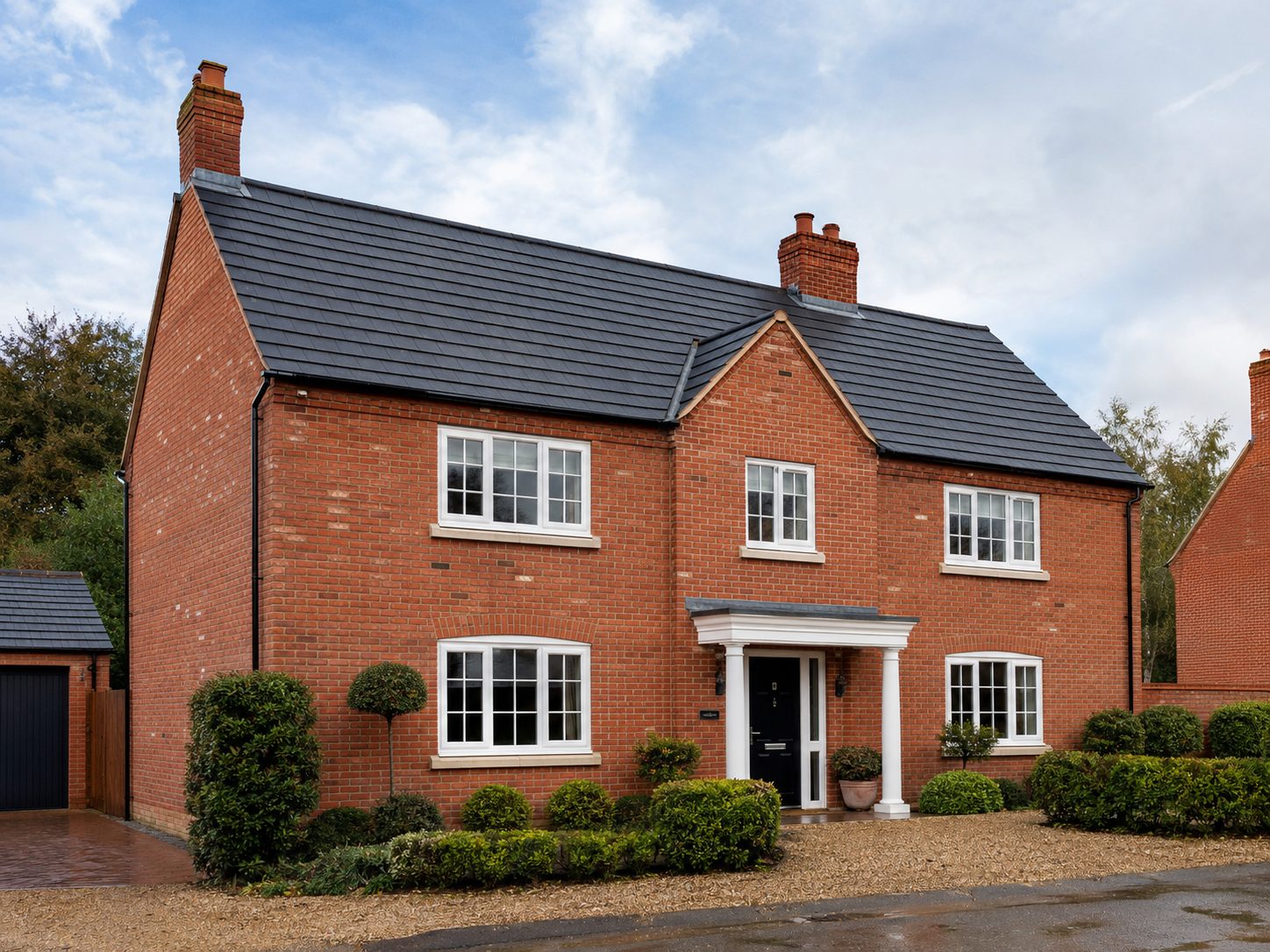
When a roof comes off, the question of what goes back on is often decided by whichever tile the roofer happens to buy most of. It deserves more thought than that, particularly in Norfolk, where the traditional clay pantile is not a style choice but the regional covering, and where swapping to concrete changes the look of a street. Weight, colour, longevity, cost and, on some buildings, planning all pull in different directions. Here is how each material actually behaves once it is on a roof.
Need this sorted?
Roof Replacement & New Roofs from Larke's Roofs.
Colour: fired in against applied on
This is the difference most owners notice ten years later. Clay takes its colour from the clay body and the firing, so it does not fade. It weathers, picking up lichen and softening in tone, but the colour is the material.
Concrete tiles take their colour from pigment in a surface layer. That layer is durable, but it erodes and dulls, and the grey of the concrete beneath begins to read through. A concrete roof at twenty five years rarely looks like the sample board it was chosen from.
Neither is a defect. It is a question of whether you mind the roof looking different in a decade, and whether the building sits among neighbours whose roofs it needs to match.
Weight and what the structure can carry
Concrete tiles are generally heavier per square metre than their clay equivalents, and the difference is meaningful across a whole roof. On a Victorian or Edwardian house originally covered in slate or clay pantile, putting concrete on can load rafters and purlins that were never sized for it.
The signs that this has already happened elsewhere in a street are visible from the pavement: a ridge line that dips in the middle, rafters visibly bowing between purlins, spreading at the eaves. Once a roof has deflected under a covering it was not designed for, correcting it is structural work rather than roofing work.
Where a lighter covering is wanted on an old structure, clay usually helps and a lightweight interlocking system helps more. Any change of covering material on a re-roof should include someone actually looking at the timbers first.
Roof Replacement & New Roofs
- Full strip and re-roof
- Tile, slate and pantile coverings
- New battens, membrane and ventilation
The East Anglian pantile question
Across Norfolk the clay pantile is the local vernacular, and its double curve throws a shadow line that nothing else reproduces. Concrete pantile profiles exist and they are competent products, but on a terrace of pantiled cottages the substitution is obvious from the street.
On listed buildings and in conservation areas this is not just aesthetics. Consent conditions commonly require like for like clay, and salvaged or handmade pantiles may be specified to match the existing roof. That is a conversation to have before ordering materials, not after.
It also affects value in a practical way. On period property in villages where clay dominates, a concrete re-roof tends to be treated by buyers and surveyors as something to put right later.
- Listed building or conservation area: assume clay and check the consent conditions
- Pantiled terrace or village street: matching the neighbours matters
- Modern estate housing: concrete is normally what came off and what should go back
Cost, availability and lead times
Concrete is the cheaper material and it is widely stocked, which makes it quick to source and straightforward to price. Clay costs more per tile, and handmade or specific regional profiles cost more again and can carry lead times measured in weeks.
Labour is broadly comparable for a plain interlocking roof in either material, but hand made clay, salvaged tiles and traditional detailing take longer to lay and to sort, and any honest quotation reflects that.
The whole life picture narrows the gap. Clay has a long service life, and a good clay roof can be stripped and relaid with a high proportion of the original tiles reused, which is not usually true of aged concrete.
Practical performance: frost, moss and breakage
Modern clay tiles are frost resistant to a standard and perform well through East Anglian winters. Older or poorly fired clay can spall at the surface, which is why a strip and relay always involves sorting the salvaged tiles rather than putting everything back.
Concrete is dense and robust in handling, though it can grow moss more readily on shaded north facing slopes because of its slightly more open surface texture. Neither material minds coastal air the way metal fixings and mortar do, which is why on exposed coastal roofs the fixing specification often matters more than the tile.
Both are brittle underfoot. Almost every broken tile we replace was broken by someone walking a roof without crawling boards, usually while installing something else.
What we would ask before deciding
What came off the roof originally, and is any of it worth salvaging. What the neighbouring roofs are covered in. Whether the building is listed or in a conservation area. What the rafters and purlins look like from inside the loft. How long you intend to keep the house.
Answer those five and the tile usually chooses itself. We will go through them at the inspection and set out both options in the quotation where both are genuinely viable.
Want a professional to handle it?
Common questions
Can I put concrete tiles on a roof that had clay pantiles?
Sometimes, but the structure has to be able to carry the additional weight and the appearance will change noticeably. On listed buildings and in conservation areas it is often not permitted at all.
Do concrete tiles really fade?
The pigmented surface layer weathers and dulls over time, so a concrete roof looks greyer at twenty years than at two. Clay does not fade because the colour comes from the fired clay itself.
Which is cheaper to re-roof with?
Concrete is the cheaper material and is widely stocked. Clay costs more, and handmade or matched regional pantiles cost more again and can need ordering well in advance.
Can my old clay pantiles be reused?
Often a good proportion of them can, once they are sorted and the spalled or cracked ones are set aside. Reusing salvaged tiles with new battens, membrane and fixings is common on period roofs and keeps the appearance right.
Will changing tile type affect a house sale?
On modern housing, rarely. On period and village property where clay dominates, surveyors and buyers tend to notice a concrete substitution, so it is worth weighing before the order goes in.
Related services
Covering Norwich and Norfolk.