
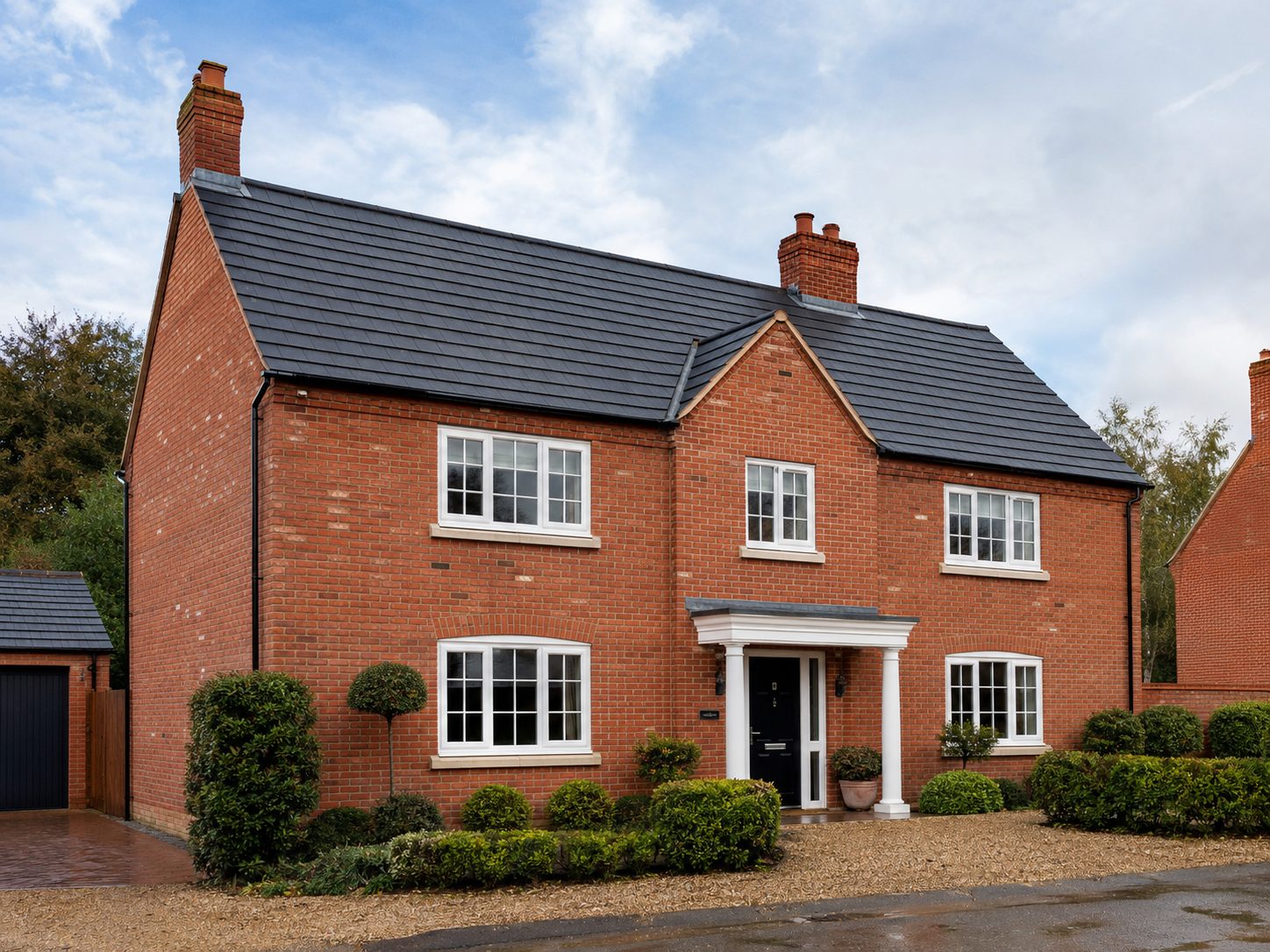
Every so often a homeowner rings us holding two quotes that are thousands apart, and the difference turns out to be that one is stripping the roof and the other is battening over what is already there. That is a genuine decision rather than a trick, but the cheaper option carries consequences that are rarely spelled out in the quotation. This guide sets out what an overlay is, what it hides, when it is defensible, and what to ask before you accept one.
Need this sorted?
Roof Replacement & New Roofs from Larke's Roofs.
What each one actually involves
A full re-roof strips the covering off completely, exposes the rafters, and rebuilds the roof from the structure outward: new breather membrane, new treated battens at the correct gauge, new covering, new lead, and ventilation designed in at eaves and ridge. Anything defective underneath becomes visible and gets dealt with.
An overlay leaves the existing covering in place and fixes new battens through it into the rafters, then lays the new covering on top. Nothing underneath is inspected, nothing underneath is corrected, and the old roof stays there permanently.
The cost difference comes almost entirely from labour, waste disposal and the timber and membrane that an overlay does not use.
Why we are generally against overlays
The first objection is weight. A roof structure was sized for one covering, not two. Adding a full second layer, plus battens, on rafters that may be a century old and already deflecting is a structural decision that nobody has assessed.
The second is what you cannot see. Rotten batten ends at the eaves, decayed rafter feet, perished felt, failed valley boards, defective lead: none of these are found during an overlay, and all of them are found within an hour of starting a strip. Sealing problems in does not solve them, it just moves the discovery date.
The third is ventilation. Overlaying almost always leaves the old impermeable felt in place under the new build up, which is precisely the arrangement that produces condensation on timbers. If your loft is already damp, an overlay will not help and may well make it worse.
- Structure never assessed for the additional load
- Rot, decayed timber and failed underlay left in place
- Ventilation and condensation problems preserved rather than fixed
- Eaves, verge and abutment lines thickened, so details get awkward
- The full cost simply deferred to the next owner or the next decade
Roof Replacement & New Roofs
- Full strip and re-roof
- Tile, slate and pantile coverings
- New battens, membrane and ventilation
When an overlay can be defensible
There are cases. A sound, dry, relatively young roof where the covering has failed for a specific reason but the substrate is demonstrably fine. A single storey outbuilding or garage where load and long term value are not concerns. A short term measure on a building with a known and imminent redevelopment plan.
In those cases the honest test is whether someone has actually verified the condition underneath, from the loft, at the eaves, and by lifting units at several points, rather than assumed it. If nobody has looked, it is not a considered decision, it is a gamble with the customer's money.
The questions to ask about any overlay quote
If you have been offered one, these five questions will tell you quickly how much thought has gone into it.
- Has anyone assessed whether the structure can take the extra weight?
- What has been done to verify the condition of the battens and rafters?
- What happens to loft ventilation and the existing felt?
- How will the eaves, verges and flashings be re-detailed at the new height?
- What exactly is guaranteed, given the substrate has not been inspected?
Resale, surveys and the long view
An overlaid roof shows up in a homebuyer survey, and a surveyor who spots a double layer will normally flag it, which can affect negotiations. Buyers of period and higher value property in particular tend to treat it as deferred work rather than completed work.
There is also the simple arithmetic. Doing the job properly once costs more today than doing it cheaply today, but doing it cheaply today and properly in eight years costs the most of all, including a second scaffold. If you are staying in the house, that arithmetic usually decides it.
We quote for full re-roofs as standard. Where an overlay is genuinely the sensible option for your building, we will say so and explain why.
Want a professional to handle it?
Common questions
Is overlaying a roof against the building regulations?
It is not automatically prohibited, but a significant recovering brings requirements around structure, weathertightness and thermal performance into play, and the extra load has to be justified. Anyone proposing an overlay should be able to explain how those points are addressed.
How do I tell if my roof has already been overlaid?
Look at the thickness at the verge and the eaves, and look in the loft at the underside of the roof between the rafters. A double layer usually shows as an unusually deep edge detail and old felt or the back of old tiles visible above the new battens.
Is a re-roof much more disruptive?
There is more noise, more skip traffic and the roof is open at some point, so it is scheduled around the weather. In exchange, everything underneath is seen, corrected and renewed. Most people find that trade acceptable once they understand what an overlay leaves behind.
Can you inspect a roof someone else has quoted an overlay on?
Yes. We inspect free of charge and will tell you plainly what condition the roof is in, including if the existing covering has more life in it than either quote assumes.
Related services
Covering Norwich and Norfolk.