
Chimneys take more weather than any other part of a house. They stand proud of the roof on all four sides, they are exposed at the top, and they are built from brick and mortar that has often had a century of frost cycles. When a chimney starts to fail, the water usually shows up on the chimney breast in a bedroom rather than as a drip through the ceiling, which is why the cause is so often misdiagnosed as rising damp or condensation. This guide runs through the faults in the order we usually find them.
Need this sorted?
Roof Repairs & Leaks from Larke's Roofs.
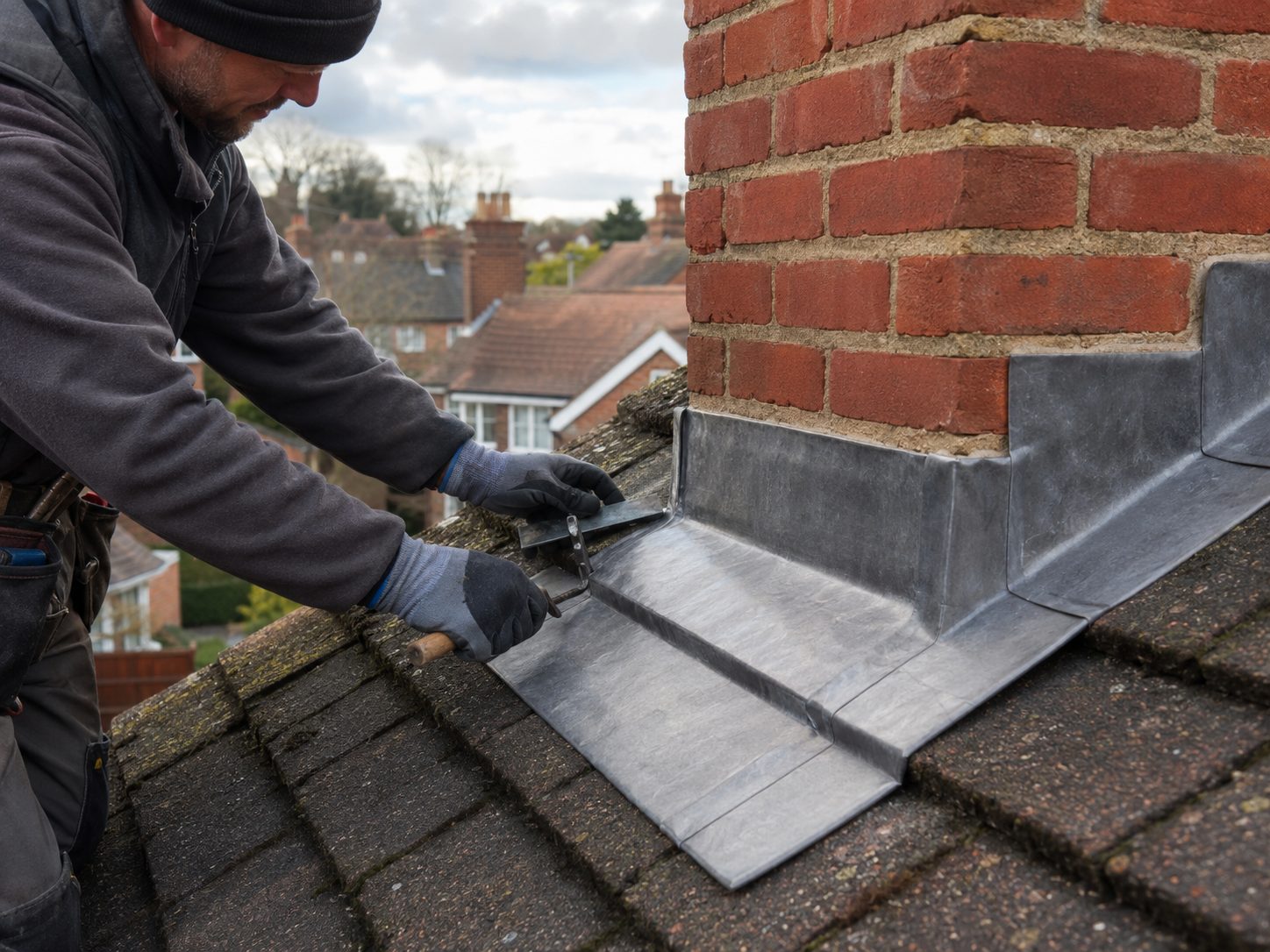
The flashings at the base
The junction between the stack and the roof slope is the most common entry point on the whole roof. It is made up of a front apron, side soakers with step flashings, and a back gutter, and any one of those failing lets water track down inside the roof rather than over it.
Failures here are easy to spot from the ground: lifted edges, rippled lead, missing mortar in the chased joints, and the tell tale silver of flashing tape where someone has tried a cheap fix. A proper repair means new lead of the right code, chased and wedged into the joints, not sealant over the old.
Flaunching, pots and capping at the top
The flaunching is the sloping mortar fillet at the top of the stack that holds the pots and sheds water off the crown. It is a thin layer of mortar in the most exposed position on the building, so it cracks, and once cracked it channels water straight down inside the stack.
Loose pots are the associated hazard. A pot sitting in failed flaunching, twenty feet up, is worth dealing with before the next gale rather than after it.
Where a flue is no longer in use, the top needs capping in a way that keeps rain out but still lets the flue breathe. Sealing a disused flue completely at both ends is a reliable way to create damp and salt staining inside the chimney breast.
- Cracked or missing flaunching, allowing water into the stack head
- Pots loose, leaning or cracked
- Disused flues capped without ventilation
- Missing or damaged cowls and bird guards
Roof Repairs & Leaks
- Leak tracing and repair
- Slipped and broken tiles
- Storm damage repairs
Brickwork and pointing
Exposed stacks lose their pointing faster than any wall on the house. Once the mortar joints are recessed, wind driven rain sits in them, freezes, and takes the face off the brick. Beyond a certain point repointing is no longer enough and the top few courses need rebuilding in matching brick.
One detail worth insisting on: the mortar mix should be appropriate to the brick. Hard modern cement mortar on soft old brick forces moisture to escape through the brick face instead of the joint, which is why so many repointed Victorian stacks start shedding brick faces a few winters later. On older and listed buildings, a lime based mortar is usually the correct answer.
Damp on the chimney breast: how to tell what it is
Three different causes produce a similar looking stain, and the fix is different for each.
- Rainwater ingress: worst after wind driven rain, often high on the breast, dries slowly
- Condensation in a cold disused flue: worse in winter, often with a musty smell
- Hygroscopic salt staining from an old soot deposit: reappears in damp weather, tide mark shaped, does not correlate with rain
Repair, reduce or remove
If the chimney is in use, or you want to keep the option of using it, repair is normally the answer: new lead, new flaunching, repointing or a rebuild of the upper courses, and the stack is good for decades.
If it is redundant, you have two other options. Reducing the stack to below the roof line and weathering over it removes the maintenance liability while keeping the internal breast and the fireplace. Full removal is more invasive, involves the breast inside, and needs the structure above supporting properly, so it is a job to plan rather than to decide on the day.
Whatever you choose, chimney work needs safe access. On most houses that means a scaffold, and a quote that does not mention how the operative is getting to the top of the stack is not a complete quote.
Want a professional to handle it?
Common questions
Why is the damp patch not directly under the chimney?
Water entering at a stack runs down brickwork or along timbers until something stops it. It commonly appears a course or two lower, or on the opposite side of the breast, and on a first floor rather than in the loft. Tracing it properly is part of the inspection.
Can a chimney be repointed without scaffolding?
We would not do stack work off a ladder. Working at the top of a chimney needs both hands, a platform and edge protection, so the scaffold is a genuine cost of the job rather than an upsell. It also means the flaunching and flashings can be done properly at the same visit.
Should I remove a chimney I never use?
Not automatically. A sound repaired stack costs little to maintain, preserves the appearance of the house and keeps future options open, which matters on period and character properties. Removal makes more sense where the stack is badly deteriorated and the roof would need major work around it anyway.
Do you re-render or repoint at the same time as the flashings?
Where a scaffold is going up we would always recommend doing everything on the stack at once. Coming back later for the flaunching after the scaffold has gone means paying for the access twice.
Related services
Covering Norwich and Norfolk.