
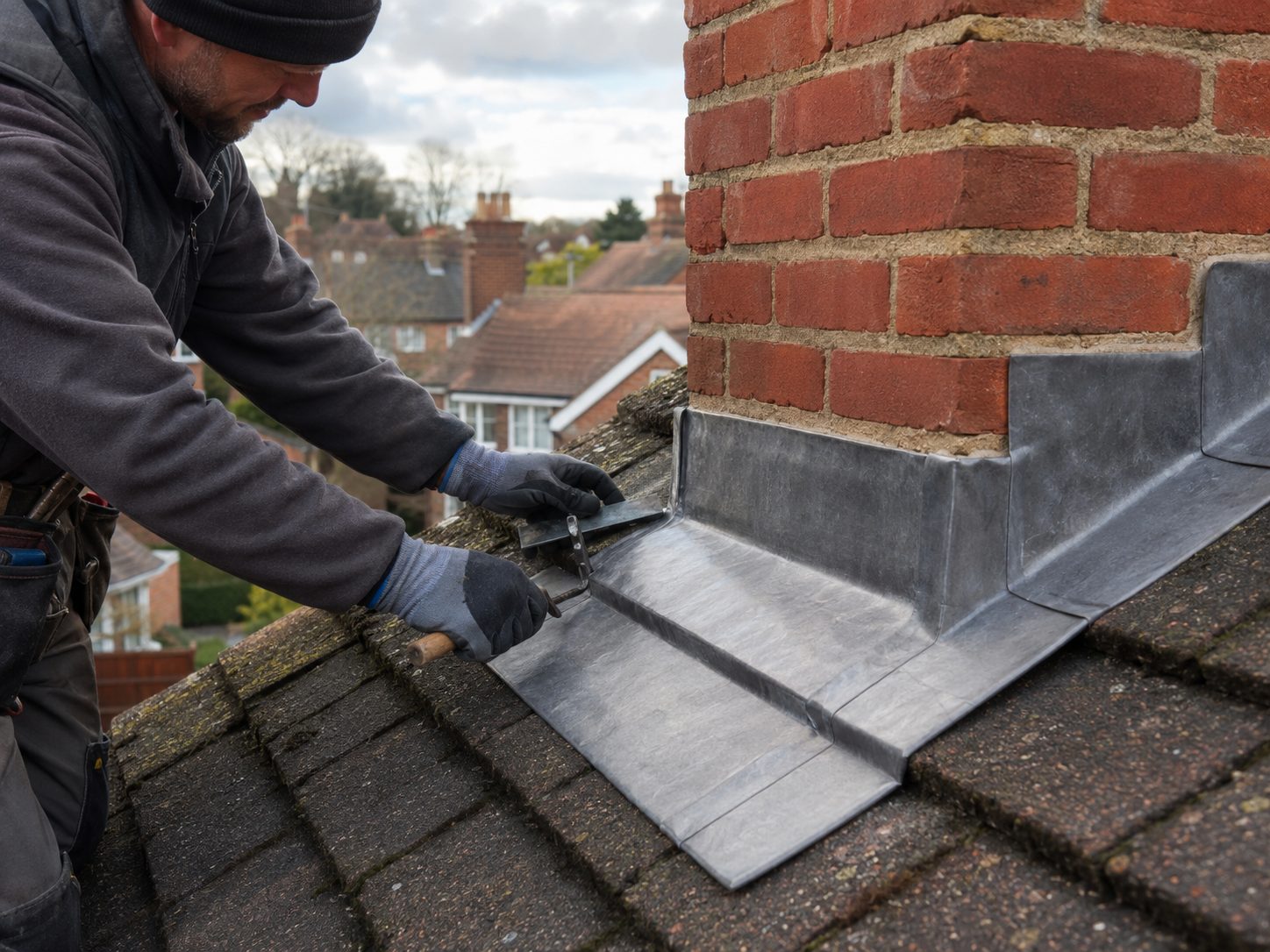
The junction between brickwork and roof covering is the hardest-working detail on a house. It has to stay watertight while two materials move at different rates, in different weather, for decades. When a roof leaks near a chimney, the flashing is the first thing worth looking at and usually the thing that has failed.
Need this sorted?
Roof Repairs & Leaks from Larke's Roofs.
Cement fillets are the usual reason
A sand-and-cement fillet run around a stack is quick and cheap, and it will look fine for a couple of years. Then it cracks, because mortar has no give in it and the roof and chimney do not move together. Once it has hairline cracked, water goes straight in behind it and the fillet then holds the water there rather than shedding it.
The proper detail is lead: a stepped apron cut into the mortar joints on the sides, soakers interleaved with the tiles or slates, an apron at the front and a back gutter behind the stack. Cut in, wedged, pointed and dressed down so water is thrown out onto the covering rather than allowed behind it.
The back gutter is the part people forget
Water coming down the slope has to get around the stack, and on the upslope side it collects in the back gutter. That is the detail that takes the most water and the most debris, and it is frequently the one that has been formed badly or left out altogether on older work.
If the damp inside is worse on the upslope side of the chimney breast, the back gutter is the first thing we look at.
Roof Repairs & Leaks
- Leak tracing and repair
- Slipped and broken tiles
- Storm damage repairs
It is not always the flashing
A stack can also let water in through its own fabric. Open bed joints, spalled bricks, a missing or cracked flaunching at the top and unlined flues on a disused chimney all draw water in and carry it down inside the breast, which looks exactly like a flashing leak from indoors.
- Perished pointing letting water into the brickwork
- Cracked flaunching around the pots
- Redundant flues with no cap, letting rain straight down
- Missing or corroded flue liners
How we put it right
For a full re-flash we strip the failed fillet or old lead, rake out the mortar joints, cut and dress new lead to shape on site, wedge and repoint it, and lift and relay the surrounding tiles or slates with soakers where the covering needs them. Where the stack itself is the problem we repoint, renew the flaunching or cap a disused flue at the same time so the roof is only opened up once.
Want a professional to handle it?
Common questions
Can a chimney be re-flashed without scaffolding?
Small aprons can sometimes be done from a roof ladder, but a full re-flash with a back gutter needs safe access around the stack. We will tell you honestly at the quote stage which of the two your job needs.
Is lead still the right material?
For most pitched roofs, yes, it can be dressed to complex shapes, it lasts for decades and it can be re-dressed rather than replaced. There are lead-alternative flashing systems that suit certain details and we will suggest one where it genuinely fits better.
My chimney is not used any more. Should I remove it?
Not necessarily. Capping the flue with a vented cowl, sorting the flaunching and re-flashing is usually far less disruptive than taking a stack down and making the roof good. Removal makes sense mainly where the brickwork itself is beyond repair.
How long does a re-flash last?
Properly cut-in and dressed lead is a long-life detail measured in decades, not years. That is the whole argument against replacing it with a mortar fillet the next time someone offers a quick fix.
Related services
Covering Norwich and Norfolk.