
A stain on a bedroom ceiling is the end of the journey, not the beginning. Water enters at one point, runs along a rafter, a felt lap or a batten, and drops through wherever it finds a gap in the plaster. That is why patching directly above the stain so often fails: the damage is visible in one place and the fault is somewhere else entirely.
Need this sorted?
Roof Repairs & Leaks from Larke's Roofs.
Why the damp patch is not the leak
Inside a pitched roof, water follows the timber. A leak at a chimney flashing can track two or three metres down a rafter before it soaks into the ceiling below, and on a shallow pitch it can travel further still. On a flat roof the water spreads across the deck and finds the nearest joint or fixing hole.
So the first job is always to look from inside. Daylight through the covering, wet or blackened timber, staining on the underside of the membrane and rusted nail heads all point back towards the entry point far more reliably than the ceiling stain does.
The order we check things in
Most leaks we attend in Norfolk come from a small number of repeatable places, and checking them in order saves time and money on the repair.
- Flashings and soakers around chimneys, abutments and dormers
- Valleys where two roof slopes meet and debris collects
- Slipped, cracked or missing tiles and slates, especially after wind
- Ridge and hip mortar that has cracked and let water behind it
- Verges and bargeboards on the gable end that takes the prevailing wind
- Blocked or split gutters and outlets pushing water back under the covering
Roof Repairs & Leaks
- Leak tracing and repair
- Slipped and broken tiles
- Storm damage repairs
What the repair usually looks like
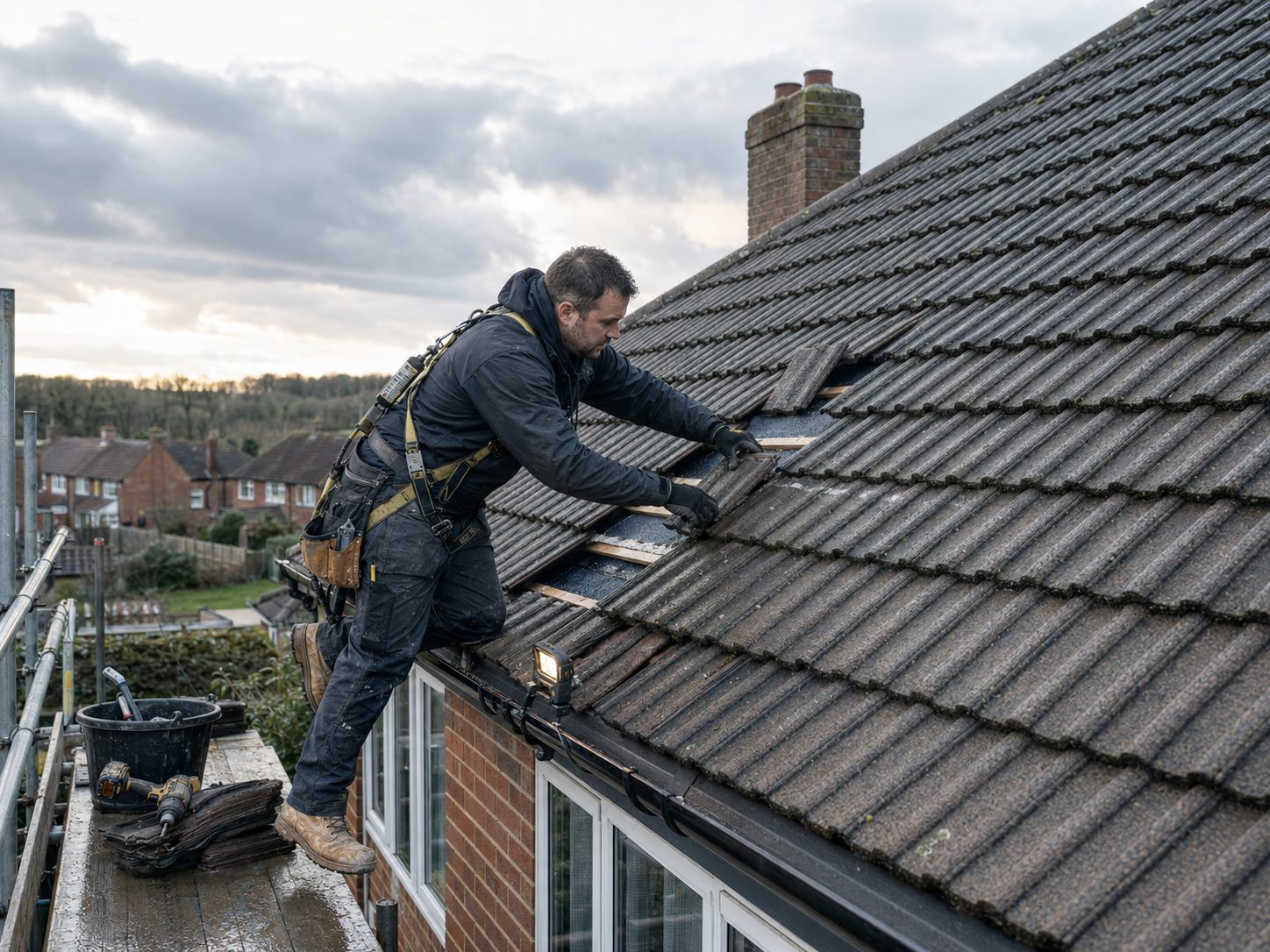
Once the entry point is confirmed the fix is often modest, a new lead flashing dressed properly into the brick joint, a replacement valley, a handful of tiles and clips, or a section of ridge re-bedded and pointed. Problems only get expensive when a leak has been running long enough to rot battens and rafter ends, because then the covering has to come off to reach sound timber.
We quote in writing before anything starts, and we say clearly when a repair is a genuine fix and when it is a holding measure on a covering that is coming to the end of its life.
What to do before we arrive
Move what you can out from under the leak and put a container down. If a ceiling is bulging with trapped water, it is usually safer to release it deliberately with a small hole into a bucket than to let it collapse. Take a photo of the stain and note the weather and wind direction when it appears, a leak that only shows in driving rain from one direction tells us a great deal before we set foot on the roof.
Porches, roof lanterns and repair scope
A leaking porch roof can fail at its wall connection, trim or outlet, not only at the centre of the surface. A roof lantern adds raised kerbs and surrounding junctions that also need inspection. Water near a lantern does not prove the glazing unit is faulty; the path through the covering and adjoining details needs checking.
Keep roof leak repair separate from making good a damaged ceiling. The roofing work stops the source, while indoor finishes may need drying and separate attention. When comparing ceiling leak repair services, ask whether the quotation includes roof investigation, internal repairs or both, rather than assuming they are interchangeable.
Roof leak costs and home insurance
Roof leak cost depends on the entry point, safe access and the extent of damage beneath the surface. An isolated flashing repair is a different scope from opening a soaked deck or replacing a failing covering. The quotation should say what is included and how additional concealed damage will be discussed.
Whether you can claim a roof leak on home insurance depends on your policy, the cause and the circumstances. Our insurance inspections and reports can provide evidence, but cannot decide cover. Speak to the insurer about their requirements and do not assume long-standing deterioration is treated in the same way as sudden storm damage.
Want a professional to handle it?
Common questions
Why does my roof only leak in heavy rain?
Wind-driven rain is pushed sideways under laps, verges and flashings that cope perfectly well with rain falling straight down. A leak that only appears in a storm from one direction usually points to an exposed gable, a verge or an abutment on that side of the property.
Can you find a leak without scaffolding?
Usually yes for the inspection. Ladder and loft access is enough to identify most entry points, and we only recommend access equipment when the repair itself needs safe working at height over a large area.
Will one repair be enough?
It depends what we find. A single failed flashing is a one-visit job. Where a covering has multiple failures across the slope, we will say so and price both the repair and the longer-term option rather than sell you repeated patches.
Do you charge to come and look?
Inspections and written quotations are free. Emergency call-outs to make a roof safe are a separate job and we agree that with you on the phone first.
Does a roof lantern leak mean the lantern needs replacing?
Not necessarily. The surrounding kerb, flashing and roof covering can also admit water, so the source needs inspection before choosing the repair.
What should I do when my roof is leaking?
Keep away from sagging ceilings and wet electrical fittings. Where safe, move belongings, catch drips and note the weather, then call to discuss the roof inspection.
Can I claim a roof leak on home insurance?
Only your insurer can confirm cover under your policy. The cause, circumstances and exclusions matter; our inspection report does not guarantee acceptance.
Related services
Covering Norwich and Norfolk.