
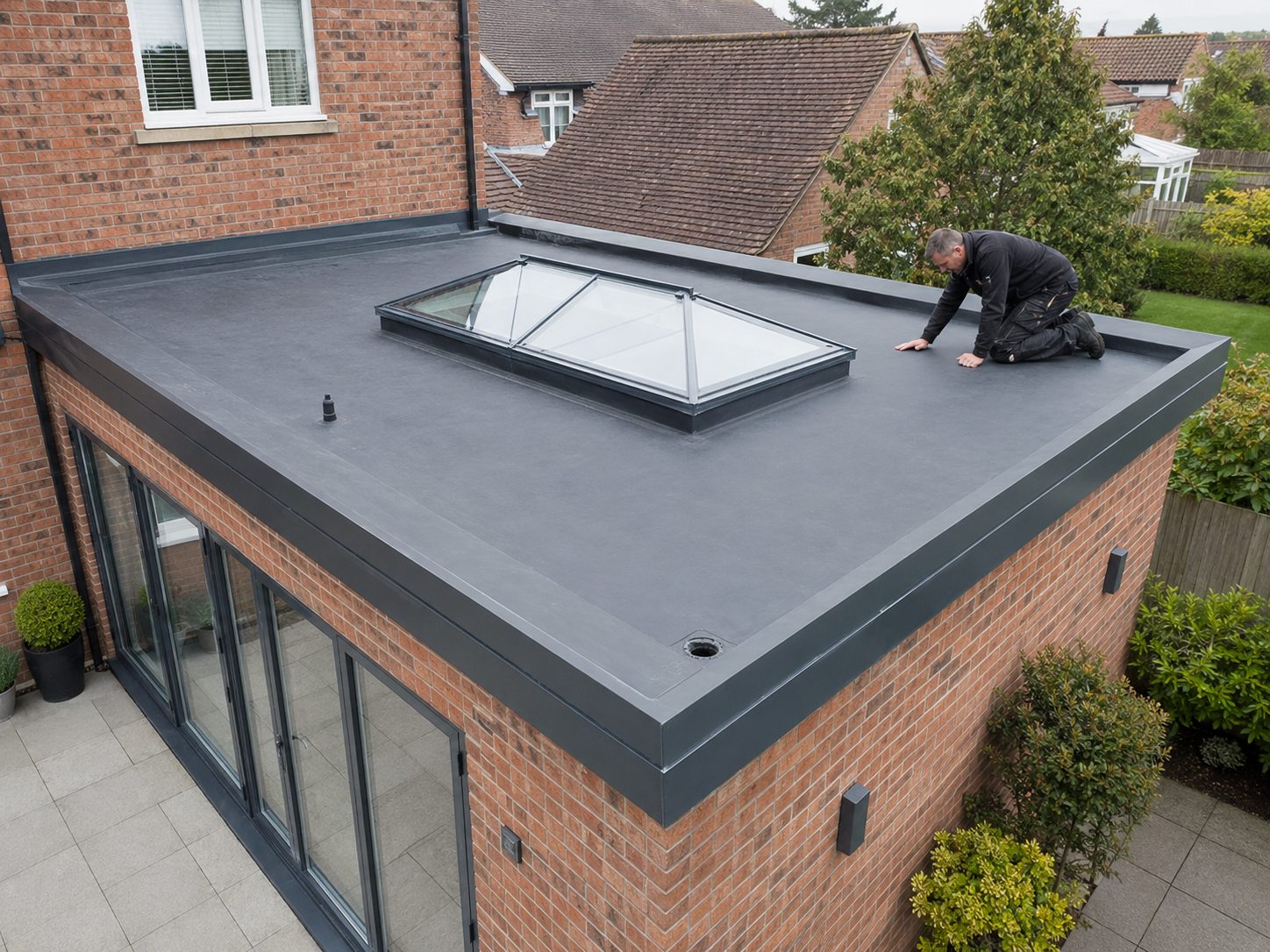
Flat roofs are not flat. They are laid to a fall so water leaves. When water sits for days after rain, something in that chain has failed: the fall was never right, the deck has deflected, or the outlet is not clearing. Ponding is rarely the leak itself, but it is very often the reason a leak appears later.
Need this sorted?
Flat Roofing & EPDM from Larke's Roofs.
What standing water actually does
Water sitting on a covering magnifies every weakness underneath it. On built-up felt it softens the surface and accelerates blistering. On GRP it finds hairline crazing and pinholes at fibre-rich spots. Even on EPDM, which tolerates standing water far better than the alternatives, ponding collects grit and debris that abrade the membrane and it puts constant load on a deck that may already be sagging.
It also freezes. A pond that ice-heaves in January will lift laps and trims that survived the whole of the previous summer.
Why the water is not leaving
There are only a few real reasons, and identifying which one you have determines whether this is a cheap job or a proper rebuild.
- The roof was laid without adequate fall in the first place
- Chipboard or ply decking has swollen and deflected between joists
- Joists have deflected under load or with age
- The outlet or gutter is blocked, or sits higher than the low point
- A later extension or upstand has dammed the flow path
Flat Roofing & EPDM
- EPDM rubber roofs
- GRP fibreglass roofs
- Torch-on felt systems
How falls are corrected
Where the deck is sound and the fall is merely inadequate, tapered insulation laid over the existing deck creates a correct fall and improves the thermal performance at the same time. Where the deck itself has failed, it comes off, any wet insulation is removed, deteriorated joists are addressed, and firrings are set out to give a consistent fall to the outlet before the new system goes down.
We measure the fall and find the low point rather than guessing from where the puddle happens to be sitting on the day.
Getting the drainage right
The outlet has to be at the low point, sized for the area it drains, and accessible enough that it can actually be cleared. On small extension roofs we frequently find a single outlet choked with moss from the pitched roof discharging above it, in that case a leaf guard and an annual clear does more good than any amount of membrane work.
Want it looked at? See our flat roof repairs and replacement across Norfolk.
Want a professional to handle it?
Common questions
Is a small puddle on a flat roof always a problem?
Not on day one. Guidance accepts limited residual water after rain. Water that is still there 48 hours later in dry weather, or a pond deep enough to hold debris, is a design or deck issue worth addressing.
Can ponding be fixed without replacing the whole roof?
Sometimes, clearing an outlet or building up a low spot with tapered insulation under a new membrane. If the deck has deflected, a full strip and re-deck is the only durable answer.
Which flat roof system copes best with standing water?
EPDM handles it best of the common systems, GRP is next, and felt is the least tolerant. That said, a system chosen to survive ponding is not a substitute for laying a correct fall.
Will you tell me if the roof only needs a clean?
Yes. If the fix is clearing an outlet and fitting a guard, that is what we will quote for.
Related services
Covering Norwich and Norfolk.