
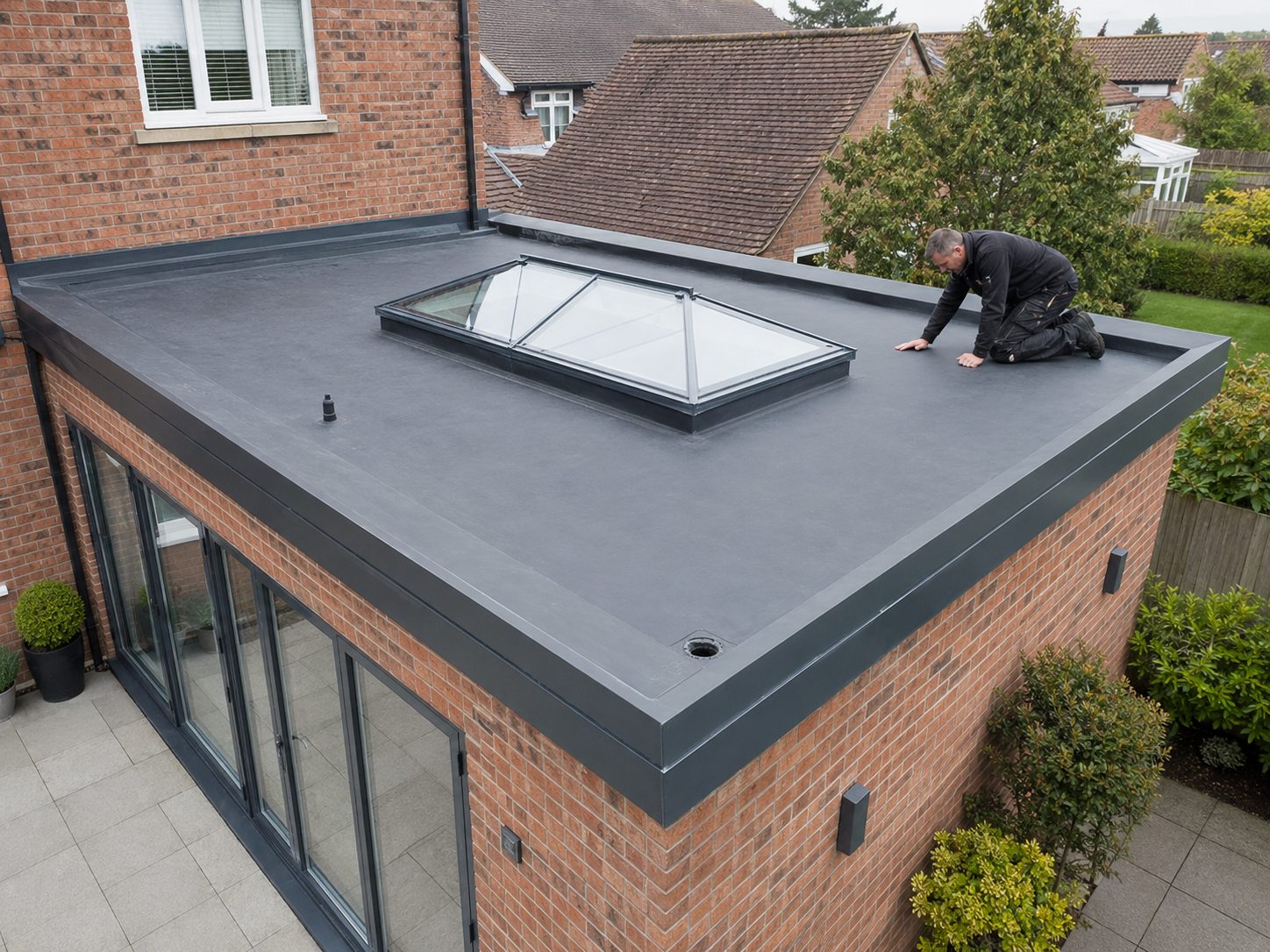
Flat roof failures announce themselves visually long before they leak. A bubble under felt, a spider-web of fine cracks in fibreglass, a lap that has opened at the edge, each is a different mechanism with a different prognosis, and knowing which one you are looking at is the difference between a sensible repair and money spent twice.
Need this sorted?
Flat Roofing & EPDM from Larke's Roofs.
Blistering on felt
A blister is vapour. Moisture trapped between layers, or in a damp deck below, expands in the sun and lifts the membrane. Small, firm blisters that have been there for years and are not at a lap can often be left alone. Soft blisters, blisters that have burst, and blisters clustered in one area mean the deck below is wet and a patch will simply move the problem sideways.
Crazing and cracking on GRP
Fibreglass is rigid, so it fails where the structure moves and it cannot. Fine crazing across the surface is usually cosmetic weathering of the topcoat. Cracks running in a line, particularly over a joist, a deck joint or an upstand, mean movement the laminate cannot absorb, those need cutting out and laminating in, and if the deck is moving that much the deck needs sorting first.
Flat Roofing & EPDM
- EPDM rubber roofs
- GRP fibreglass roofs
- Torch-on felt systems
Lap and detail failures on membranes
Single-ply and EPDM sheets rarely fail in the middle of the field. They fail at the joins and the edges, which is where the workmanship is.
- Bonded laps that were contaminated or under-rolled when installed
- Corners and upstands where the sheet was stretched rather than cut and welded
- Perimeter trims and drip edges lifting after wind
- Pipe and outlet penetrations sealed with mastic instead of a proper collar
Repair or recover
Isolated damage on a covering with years left is worth repairing properly. Widespread failure, a wet deck or a roof that has already been patched several times is a recover job. The test we apply is simple: if we cannot honestly expect the repair to still be sound in three years, we say so and quote the replacement instead of taking money for a patch.
Want it looked at? See our flat roof repairs and replacement across Norfolk.
Want a professional to handle it?
Common questions
Should I pop a blister in my felt roof?
Not as a DIY fix. Cutting one open lets water into the layers. If a blister needs opening it should be cut, dried, primed and patched in with new material in the same visit.
Can liquid coatings save an old flat roof?
A liquid overlay can extend life on a covering that is dry, well-drained and structurally sound. Applied over a wet deck or a ponding roof it seals the moisture in and hides the problem for a couple of years.
How do I know if the deck underneath is wet?
Soft or springy areas underfoot, sagging visible from below and staining on the ceiling all point that way. Once wet, the boards do not dry out under a sealed membrane and they need replacing.
How long should a new flat roof last?
As a general guide, torch-on felt around 15-20 years, GRP around 20-25, and EPDM 25 years or more when detailed and drained correctly. Falls and workmanship matter more than the material name.
Related services
Covering Norwich and Norfolk.