
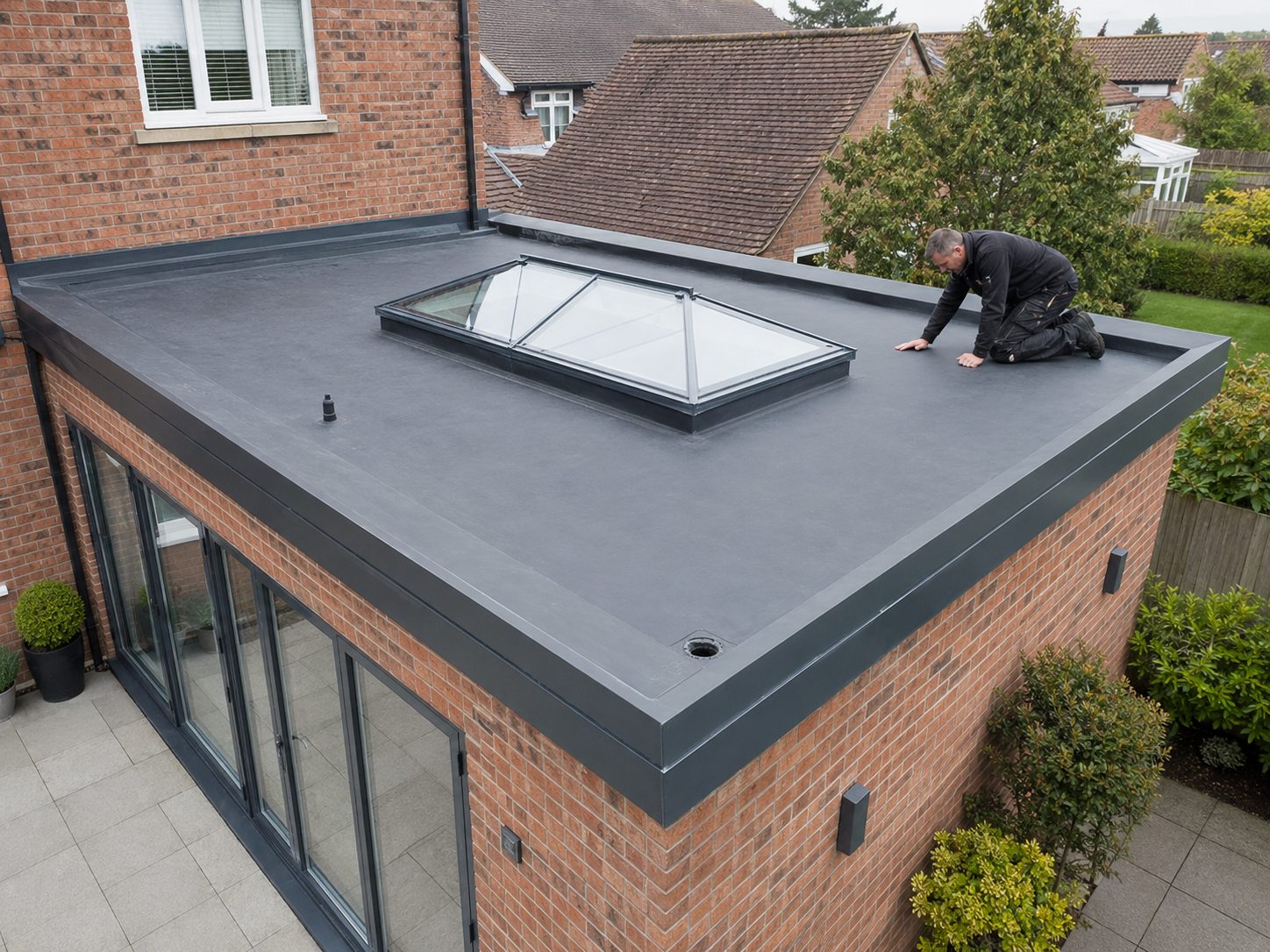
EPDM is a synthetic rubber membrane that arrives as one large sheet and is bonded to the deck. On most domestic flat roofs, a garage, an extension, a dormer, the whole area can be covered without a single joint in the field of the roof, and joints are where flat roofs leak. That is the core of its appeal.
How it goes down
The deck is prepared and checked for falls, the sheet is laid out and allowed to relax, then it is bonded down with contact and deck adhesives. Edges are finished into metal trims, drip edges, gutter trims and kerb trims, and upstands are dressed and bonded to the vertical face rather than simply turned up loose.
Corners, pipe penetrations and outlets are formed with pre-moulded or bonded detail pieces. This is where quality shows: the field of an EPDM roof is straightforward, the details are the craft.
Where it performs best
It flexes with the building rather than resisting it, which is why it copes with timber decks that move. It tolerates standing water better than felt or GRP, so it is forgiving on roofs where the fall is not perfect. It has no seams to open and no resin to craze, and it stays flexible in cold weather.
- Extensions, garages, porches and dormers
- Roofs overlooked from a window, where the finish is visible
- Decks with slight movement or imperfect falls
- Warm-roof build-ups with insulation above the deck
Its limits
It is not the right answer everywhere. It is a dark, matt membrane and some clients dislike the look next to a tiled roof. It is not designed for regular foot traffic without a protective walkway layer, and it can be punctured by sharp debris. Very large or heavily penetrated commercial roofs are often better served by a mechanically fixed single-ply system.
It also cannot rescue a wet deck. Bonding a new membrane over saturated boards seals the water in.
What we check before quoting
We look at the deck condition, the fall and low point, the outlet position and size, the upstand heights against adjoining walls and door thresholds, and whether the build-up should be warm or cold. If the answer is that the deck must come off first, we say that in the quote rather than discovering it on the day.
An EPDM flat roof is more than a sheet of rubber
When deciding on rubber roofing, start with the building beneath it. A dry, stable deck and an outlet that receives the runoff are as important as a membrane with few field joints. On a garage, the inspection needs to establish whether the boards can stay. On an extension, the connections to walls and thresholds also shape the specification.
Plywood can form the deck in an EPDM roofing system, but its presence does not establish that the roof is ready to cover. The boards need to be dry and sound, with suitable falls and a surface prepared for bonding. A damp board hidden under old felt is a reason to investigate the build-up, not a reason to seal it beneath rubber.
Repairing details or choosing a replacement
An EPDM roof repair enquiry should identify whether the problem lies at a trim, a penetration or a damaged area of membrane. Sharp debris and unprotected traffic can puncture rubber, while water at a wall may concern the upstand rather than the open roof surface. The repair method follows that diagnosis and the condition around it.
If you are comparing EPDM with GRP, describe how the roof will be used. Flexibility suits moving timber decks; a hard laminate offers a different finish where access and use matter. Rubber roof cost also changes with deck renewal, insulation and the number of details, so compare the complete proposed build-up rather than the membrane alone. The flat roofing service brings those inspection and installation choices together.
Want it looked at? See our flat roof repairs and replacement across Norfolk.
Common questions
How long does an EPDM roof last?
Commonly quoted at 25 years or more, and the membrane itself typically outlives that. Realistic life depends far more on the deck, the falls and the detailing than on the rubber.
Can EPDM be laid over an existing felt roof?
Only where the existing covering is dry, well bonded and sound. In most cases we recommend stripping back to the deck so the condition of the boards can actually be seen.
Can you walk on it?
For maintenance access, yes, with care. For a roof designed to be used as a terrace or balcony, a walk-on protection layer needs designing in from the start.
Is EPDM better than fibreglass?
For most domestic extension and garage roofs we would choose EPDM for its jointless field and tolerance of movement. Where a hard, walkable, seamless finish is wanted, GRP has real advantages. Neither is universally better.
How is rubber roofing applied?
The membrane is laid out, allowed to relax and bonded to a prepared deck. Trims, upstands, corners and outlets need compatible detailing, not just adhesive across the open surface.
Can EPDM be installed on plywood?
Plywood is among the decks described for this system. Its condition, dryness, preparation and roof falls need checking before the membrane is bonded.