
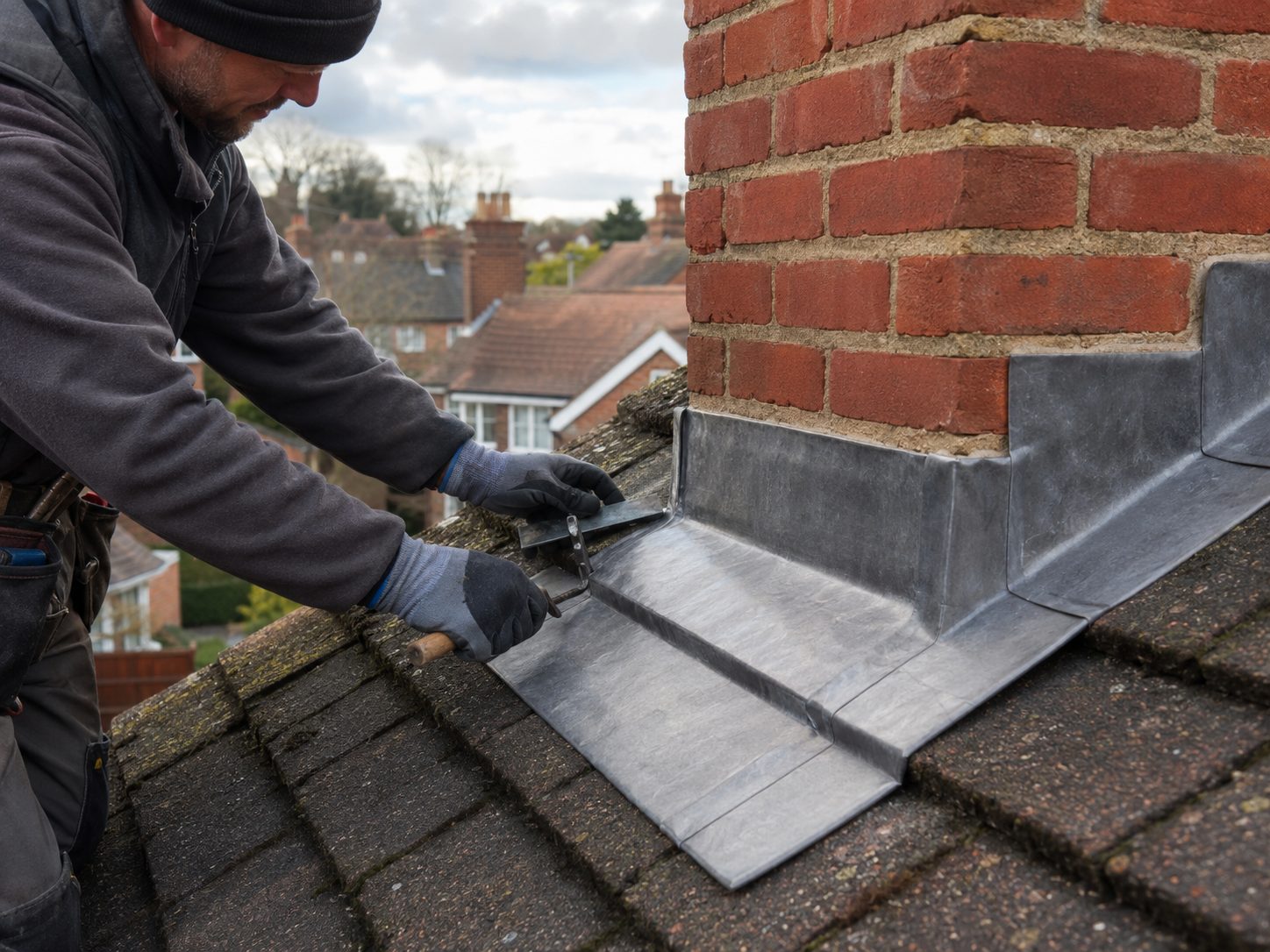
Lead is the oldest material still routinely used on modern roofs, and it survives because nothing else does the same job as well. Wherever a roof meets something that is not a roof, a chimney, a wall, a change of pitch, a valley, water has to be led over the joint rather than sealed out of it. That is what lead does. This guide explains the main details, what the codes mean, why lead fails, and why a sealant repair to a lead joint is almost always a temporary fix.
Need this sorted?
Roof Repairs & Leaks from Larke's Roofs.
Why lead and not something else
Lead is malleable enough to be dressed by hand into the exact shape of a chimney, a tile profile or a valley, and it holds that shape without springing back. It is also extremely durable, unaffected by ultraviolet light, and it forms its own protective patina rather than corroding through.
Just as importantly, it can be installed as separate overlapping pieces that are free to move. Every material on a roof expands and contracts, and lead accommodates that movement if it is cut into sensible lengths and fixed at one edge only. That principle explains almost everything about good leadwork.
Codes: what the numbers mean
Milled lead sheet is graded by code, which corresponds to thickness, and each code has a colour marking. Higher code numbers are thicker, heavier and more durable, but also less easy to dress into fine detail.
On domestic roofing in this region, code 4 and code 5 cover most work. Lighter codes have their uses on soakers and small pieces, while heavier codes are used where exposure, span or traffic demands it. A quote that specifies the code is telling you something useful. A quote that just says lead flashing is not.
- Code 3: light work, soakers and small concealed pieces
- Code 4: the general purpose domestic flashing weight
- Code 5: chimneys, valleys, exposed abutments and heavier detail
- Code 6 and above: larger valleys, parapet gutters, heavy exposure
Roof Repairs & Leaks
- Leak tracing and repair
- Slipped and broken tiles
- Storm damage repairs
The details you will hear named
Understanding the vocabulary makes any roofing conversation easier, and it makes it obvious when a quote has skipped something.
- Front apron: the piece across the lower face of a chimney
- Soakers: small individual pieces interleaved with each course of tiles or slates at a side abutment
- Step flashing: the stepped pieces chased into the brick joints over the soakers
- Back gutter: the piece behind a chimney that carries water around it
- Saddle: the small folded piece where a ridge meets an abutment
- Valley lining: continuous lead in the trough between two slopes
- Cover flashing: the piece that laps over an upstand on a flat roof
Why leadwork fails
The commonest cause by far is thermal fatigue. A piece of lead cut too long expands and contracts against its own fixings until it cracks, usually in a straight line along the point of greatest restraint. This is why good practice limits the length of individual pieces and laps them rather than running one heroic strip the whole way.
The second cause is fixing. Lead should be held at its upper edge and left free to move at the lower, with step flashings wedged and pointed into the brickwork joint. Nailed flat all round, or bedded solid in mortar, and it will tear.
The third is other people's repairs. Mastic, bitumen paint and self adhesive flashing tape over a cracked lead joint trap water behind them, hide the fault and make the eventual proper repair harder. If you can see silver tape on your chimney, that is a repair waiting to be redone.
What good leadwork looks like from the ground
You can judge a lot without leaving the garden. Step flashings should follow the brick courses in neat, even steps, tucked into the mortar joint rather than sitting on the face. Aprons should be dressed down over the tile profile and follow its shape closely. There should be no rippling, no lifted edges and no visible sealant.
New lead is bright and will discolour to a soft grey over the first year, which is normal. A patchy white bloom on brand new lead is usually a sign it was not patination oiled after fitting, which is cosmetic rather than structural but does stain the brickwork below it.
Want a professional to handle it?
Common questions
Can lead flashing just be sealed instead of replaced?
Sealant can buy time on a small crack, and occasionally that is the right call before a planned re-roof. As a permanent fix it rarely works, because the movement that cracked the lead in the first place will crack the sealant too, and the sealed joint then holds water against the brickwork.
How long should leadwork last?
Correctly sized, fixed and lapped lead is one of the longest lasting parts of a roof and routinely outlives the covering around it. Lead that fails early has almost always been cut too long, fixed too rigidly or bedded solid in mortar.
Is lead theft still a problem?
It happens, mostly on churches and larger buildings with substantial areas of sheet lead rather than on domestic flashings. Domestic step flashings and aprons are rarely targeted because there is little weight in them.
Do you do leadwork on listed buildings?
Yes. Traditional detailing, appropriate codes and matching existing work matter far more on historic buildings, and any work should be agreed with the conservation officer where consent is required.
Related services
Covering Norwich and Norfolk.