
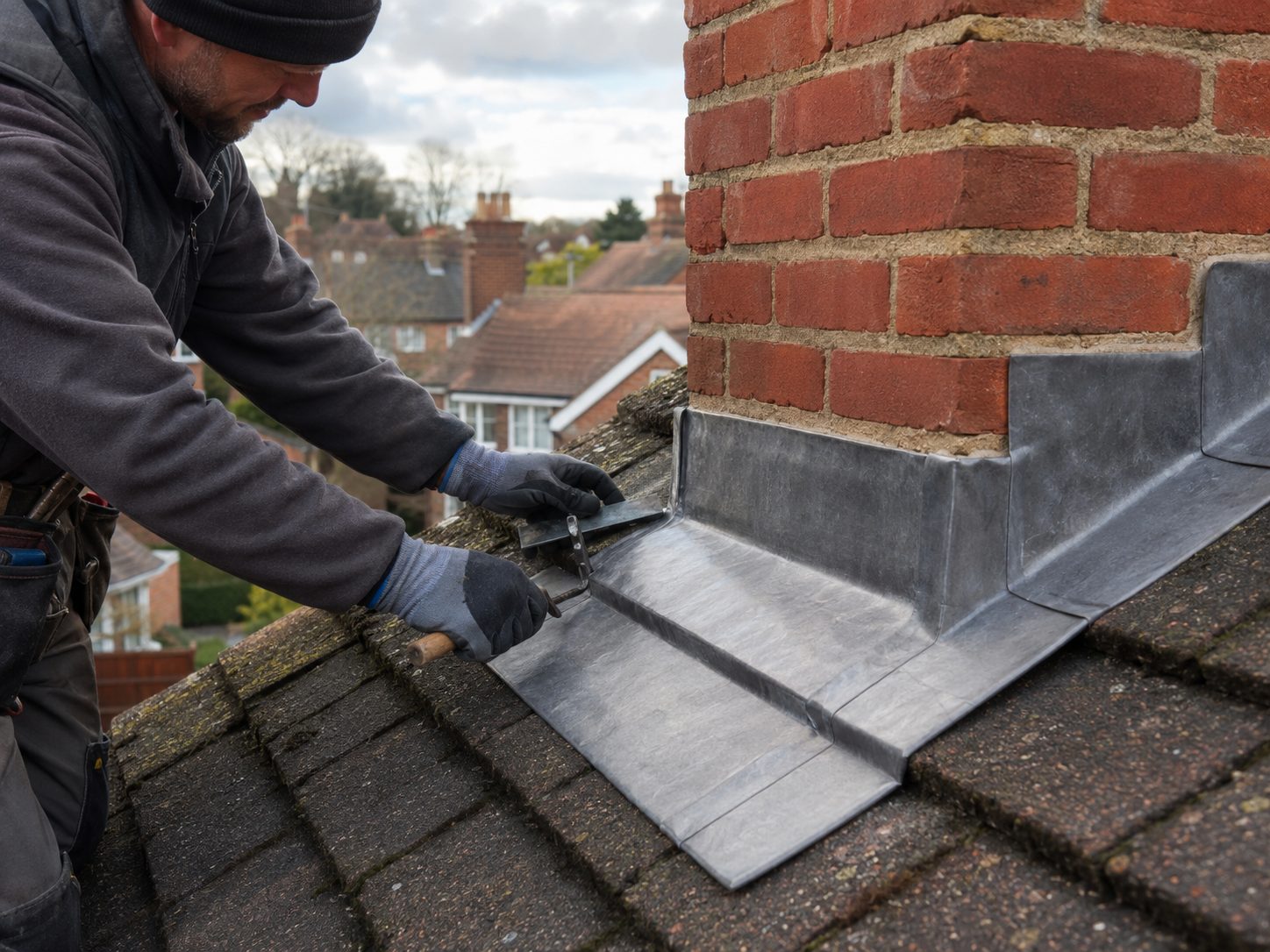
Two details take a disproportionate share of the punishment on a pitched roof. The valley concentrates the run-off from two slopes into one narrow channel, and the verge sits on the corner where wind gets under the covering. They are also two of the details most often done badly, which is why they account for so many of the repairs we are called to.
Need this sorted?
Roof Repairs & Leaks from Larke's Roofs.
Why valleys fail
Lead expands and contracts a great deal with temperature. If a valley was formed in lengths that are too long, or fixed too rigidly at both ends, that movement has nowhere to go and the lead fatigue-cracks in a straight line, usually near the middle. Add decades of grit and moss abrading the surface and a thin gauge of lead does not last.
The other common failure is at the bottom, where the valley discharges into the gutter. If the lead stops short or the tiles overhang too far, water spills behind the fascia every time it rains hard.
Replacing a valley properly
A valley replacement means stripping the tiles or slates back on both sides, renewing the valley boards where they have rotted, laying the new lead in appropriate lengths with proper laps and clips, and cutting the covering back in cleanly on both sides. Cut tiles need supporting and fixing, loose cut pieces bedded on mortar are what produce the next leak.
GRP valley liners are a reasonable alternative on some roofs and cost less than lead. We will explain which suits your covering and pitch rather than defaulting to one.
Roof Repairs & Leaks
- Leak tracing and repair
- Slipped and broken tiles
- Storm damage repairs
Verges: mortar or dry-fix
A mortar verge is the traditional detail and it does work when the mix, the undercloak and the workmanship are right. Its weakness is that it is a rigid material on the most wind-exposed edge of the roof, so it cracks, then it goes hollow, then chunks come off in a gale.
- Dry verge units clip mechanically and need no mortar
- Cloaked verge tiles give a neat traditional look with no exposed mortar
- Re-bedding on a fibre-cement undercloak where the appearance must match
- Renewing the bargeboard beneath where water has been getting in
One access, both details
Valleys and verges both need access to the slope, so it is worth surveying the whole roof before committing. We would rather quote for the valley, the verge and the two suspect flashings in one visit than have you pay for access three times in three years.
Want a professional to handle it?
Common questions
How long should a lead valley last?
Correctly specified and installed lead in a valley is a long-life detail. Most premature failures we see come from lengths being too long, gauge being too thin, or the lead being fixed so it cannot move.
Is a dry verge as good as mortar?
For durability on a modern covering, generally yes, and it removes a recurring maintenance item. On period and listed properties the traditional bedded or cloaked detail is usually more appropriate.
The valley leaks only in heavy rain, why?
That normally means the valley is overtopping rather than perforated. Either it is silted up, it is too narrow for the catchment, or the tiles on each side are cut too tight and are damming the channel.
Do you replace bargeboards and fascias too?
Yes, where the timber behind a failed verge or gutter has gone. It is common for the two to need doing together.
Related services
Covering Norwich and Norfolk.