
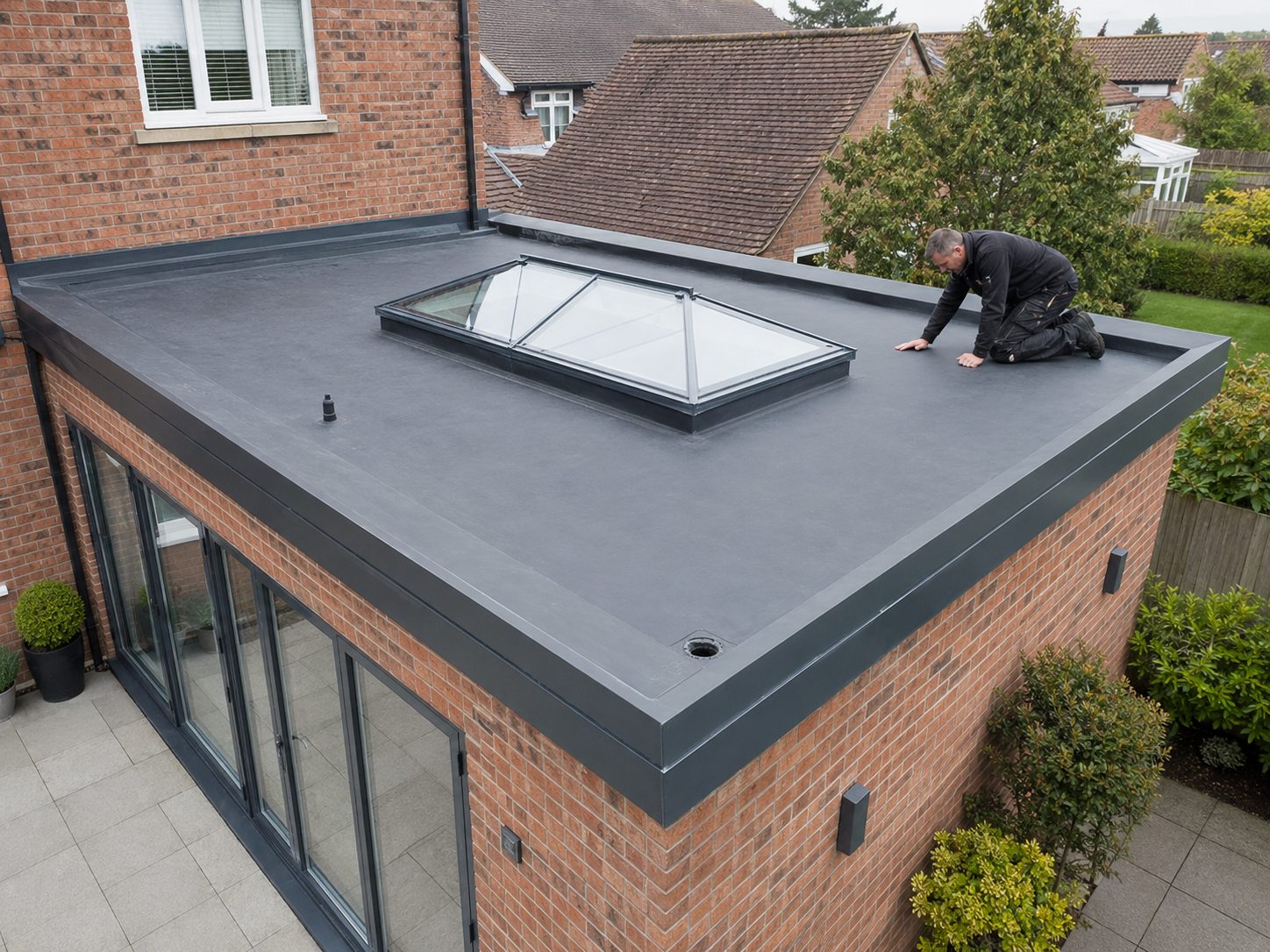
EPDM has quietly become the default flat roof covering on domestic work across Norfolk, and for good reason. It arrives as a single sheet, it has no seams across most domestic roofs, it copes with standing water better than almost anything else, and it moves with the building instead of cracking. It is also easy to fit badly. This guide covers what the material is, how a proper installation is built up, and the specific details worth checking on any quote you receive.
Need this sorted?
Flat Roofing & EPDM from Larke's Roofs.
What EPDM actually is
EPDM is a synthetic rubber sheet, typically around 1.2mm or 1.5mm thick on domestic work, supplied in wide rolls. Because the rolls are wide, most garages, extensions and dormers can be covered with a single piece of membrane, so there is no field seam for water to find.
It stays flexible across a very wide temperature range. That matters more than people expect in East Anglia, where a black roof deck can move a long way between a still frosty morning and a bright afternoon. Materials that go rigid in the cold and expand hard in the heat put stress on their own laps. Rubber simply moves.
It is also unaffected by ultraviolet light, which is what eventually destroys older bitumen felts. A rubber roof that fails almost always fails at a junction rather than in the open field.
Warm deck or cold deck: the decision that matters most
A cold deck puts the insulation between the joists, below the deck. It is cheaper, and it requires a ventilated void above the insulation, which on a shallow domestic roof is very hard to achieve properly. Get it wrong and warm moist air condenses on the cold underside of the boards, which people then report as a leak.
A warm deck puts a continuous layer of insulation above the structural deck and below the membrane, with a vapour control layer underneath the insulation. Nothing above the vapour layer is cold enough to condense, so there is no ventilation void to get wrong.
On any new or fully replaced flat roof we would ordinarily specify a warm deck. If a quote you have been given does not say which one it is, ask before you compare it with anything else.
- Warm deck: insulation above the deck, vapour control layer below insulation
- Cold deck: insulation between joists, requires a continuous ventilated void
- A warm deck raises the roof height, so check upstands and door thresholds
- Board thickness is set by the building regulations target, not by preference
Flat Roofing & EPDM
- EPDM rubber roofs
- GRP fibreglass roofs
- Torch-on felt systems
How a proper EPDM installation is built up
The old covering comes off completely. Nobody should be laying rubber over wet felt. The deck is inspected, soft or rotten boards are replaced, and where the falls are wrong they are corrected with firrings or a tapered insulation scheme rather than hoping the water will find its own way out.
The vapour control layer goes down, then the insulation boards, then the membrane, bonded with the correct contact and water based adhesives in the right places. The sheet is allowed to relax before it is dressed in, so it does not pull back off the corners a fortnight later.
Edges are finished with proprietary trims: drip trims at the gutter edge, kerb trims where the roof meets a raised edge, and a wall trim or a chased and sealed termination where the membrane runs up against brickwork.
The details that decide whether it lasts
Almost every EPDM failure we are called to is at a junction, so these are the things worth asking about explicitly when you compare quotes.
- Upstands taken a proper height up any wall and terminated mechanically, not just sealed
- Corners formed with moulded or dressed pieces rather than bunched membrane
- Outlets bonded into the membrane with a purpose made drain, not cut and mastic filled
- Any pipe or vent penetration sleeved and clamped
- Falls checked with water before the trims go on
When EPDM is not the right answer
If the roof will be walked on regularly, or something heavy will sit on it, a rubber membrane needs protection: paving on pads, a walkway layer or a different system entirely. If the roof is highly visible from a window above and appearance is a priority, some owners prefer the harder, more uniform finish of a fibreglass deck.
And if the existing structure is sound, dry and only locally failed, a repair may be the honest recommendation rather than a full replacement. We will tell you when that is the case.
Want it looked at? See our flat roof repairs and replacement across Norfolk.
Want a professional to handle it?
Common questions
How long does an EPDM roof last?
Manufacturers publish long service expectations for the membrane itself, and the material genuinely does not degrade in sunlight the way felt does. In practice the lifespan of the roof is set by the quality of the detailing and the condition of the deck below it, which is why we replace the deck where it is soft rather than covering it.
Can EPDM be laid over an existing felt roof?
We would not recommend it. Old felt traps moisture, hides rotten boards and gives an uneven surface that stops the adhesive bonding properly. Stripping back to the deck also lets us correct the falls, which is usually the actual reason the previous roof failed.
Does standing water damage a rubber roof?
EPDM tolerates ponding far better than felt or fibreglass, but standing water is still a sign the falls or the outlets are not doing their job. It collects debris, encourages growth and adds load. We would rather correct the fall than rely on the membrane to put up with it.
Can a rubber roof be repaired?
Yes. Punctures and detail failures can be patched with compatible membrane and adhesive, and a sound roof with one bad junction is usually worth repairing rather than replacing. We will always say which of the two we think you actually need.
Related services
Covering Norwich and Norfolk.