
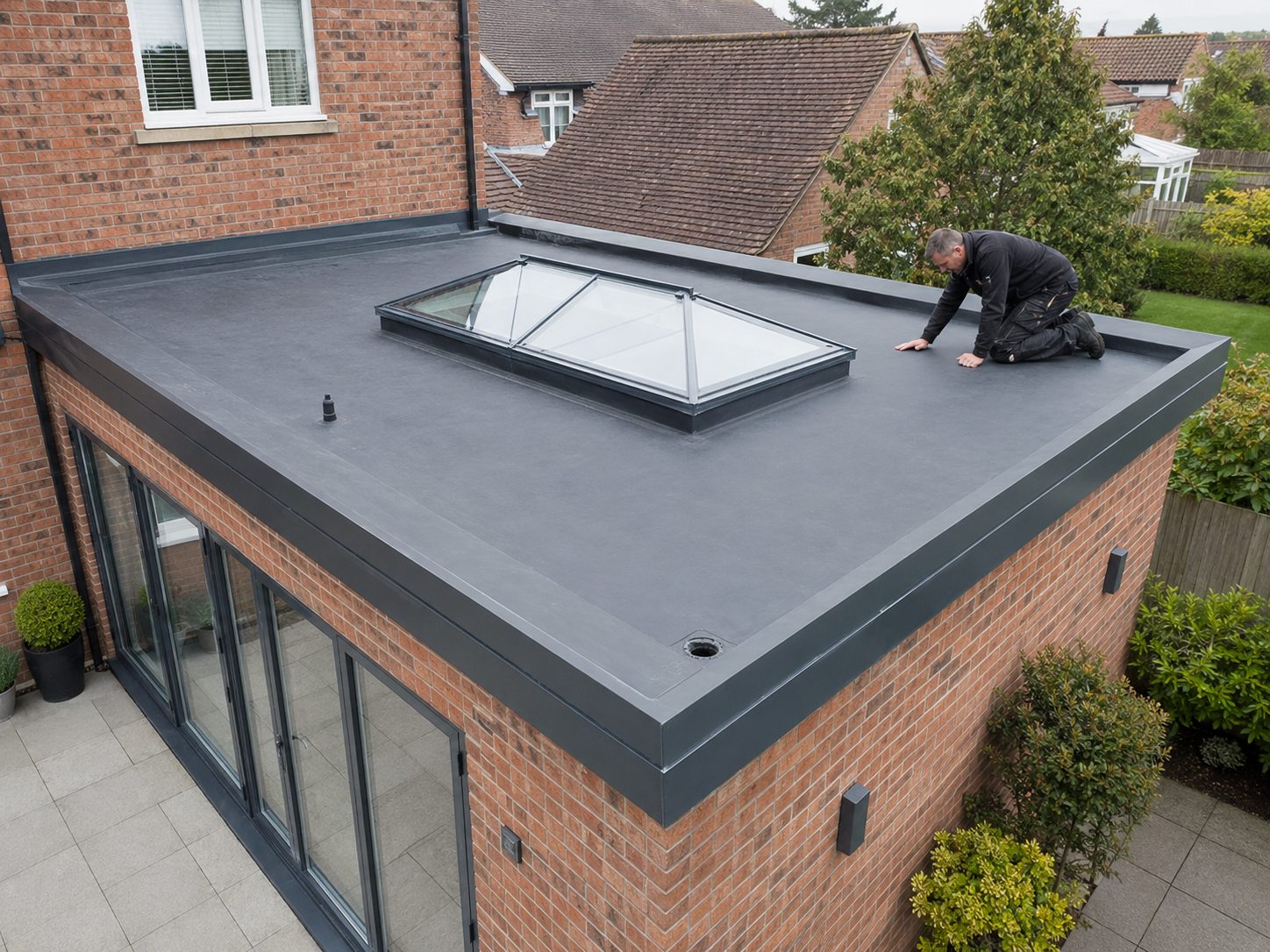
Garage roofs are the most neglected roofs on any property, which is understandable right up until the point the car, the tools and the boxes in the corner get wet. They are also, in fairness, one of the easier jobs to get right, because the shapes are simple and the access is usually straightforward. This guide covers the options, the two things that go wrong most often, and what to make sure is in the quotation before you accept it.
Need this sorted?
Flat Roofing & EPDM from Larke's Roofs.
Start by working out what you have
Most domestic garages in Norfolk fall into three groups. Timber decked flat roofs finished in bitumen felt, usually built with the house. Corrugated cement or metal sheet roofs on concrete sectional garages. And small pitched roofs, tiled or slated, on garages built to match the house.
The distinction matters because the work is completely different. A felt on timber roof is a straightforward replacement. A sheet roof on a concrete sectional garage is a different job with a specific safety consideration. A small pitched roof is simply a small version of a house re-roof.
If the roof is corrugated cement sheet and predates the ban on asbestos containing materials, treat it as potentially containing asbestos until it has been checked. Do not break it, drill it or sweep up dust from it. It needs handling and disposing of appropriately, which is a specialist matter rather than a DIY afternoon.
The two things that actually fail
The deck and the falls. Almost every garage roof we strip has soft or rotten boarding somewhere, usually along the front edge above the door where water has run back for years, or in the corner nearest the downpipe.
Falls are the other. Plenty of garage roofs were built almost dead level, or have deflected over the years into a dish, so water sits in the middle. Standing water finds every weakness in a covering, adds load, and encourages growth that blocks the outlet.
Laying a beautiful new membrane over a soft deck with no fall is money wasted. Correcting both is what separates a proper replacement from a cover up, and it is why a quote should state clearly what allowance exists for deck repair and how the fall will be created.
Flat Roofing & EPDM
- EPDM rubber roofs
- GRP fibreglass roofs
- Torch-on felt systems
Choosing the new covering
For a domestic flat garage roof the realistic choice is between rubber and fibreglass, with modern high performance felt as a third option on a budget.
- EPDM rubber: usually a single sheet with no field seams, very flexible, tolerant of ponding, quick to install
- GRP fibreglass: seamless resin and matting laid in place, hard wearing, good where the roof will be walked on, needs a stable deck
- Torch on felt: cheaper, multi layer, shorter expected life, still a reasonable option on a low value outbuilding
- Pitched tile or slate: only where the structure and the planning position allow a pitch
What a complete garage roof quote covers
The covering itself is only part of the price. These are the items worth checking are actually listed rather than assumed.
- Stripping and disposing of the existing covering
- A stated allowance and rate for replacing defective deck boards
- How the fall is being achieved, whether by firrings or tapered insulation
- New edge trims all round, and a proper bonded outlet
- New guttering and downpipe, or reuse of existing if sound
- Detailing where the garage meets the house wall, in lead or a proper termination
- Full clearance of debris and old material
Worth doing at the same time
If the roof is coming off anyway, one or two extras cost very little while the access is there. Insulating a garage roof matters if you use the space as a workshop or a gym, and it is far cheaper as part of the build up than retrofitted later.
The same goes for guttering and fascias. A rotten fascia behind a new roof edge is a job you will be back to within a couple of years, and replacing it while the covering is off is straightforward.
Finally, if the garage roof abuts the house, get the junction detailed properly in lead. That junction is where most garage roofs eventually leak, and it is the one detail that a cheap quote quietly skips.
Want it looked at? See our flat roof repairs and replacement across Norfolk.
Want a professional to handle it?
Common questions
Can you just patch a garage roof?
Sometimes, and where the deck is sound and there is one clear puncture, a patch is honest value. Where the felt is crazed all over, the deck is soft underfoot or water is standing, patching is throwing money at a roof that has already finished.
How long does a garage roof take?
A typical single garage flat roof is usually a short job once the weather allows, though deck repairs and drying time can extend it. It is weather dependent work, because the deck cannot be left open and the adhesives need suitable conditions.
My garage roof is corrugated cement sheet. What now?
Assume it may contain asbestos until confirmed otherwise, and do not disturb it. It needs assessing and, if applicable, removing and disposing of through the correct route. Tell us what you have when you call and we will advise on the right approach.
Does a garage roof need building regulations approval?
Replacing a significant proportion of a roof covering can bring building regulations into play, including thermal requirements where the space is heated. For a detached unheated garage the position is usually simpler. We will flag it if it applies to your job.
Related services
Covering Norwich and Norfolk.