
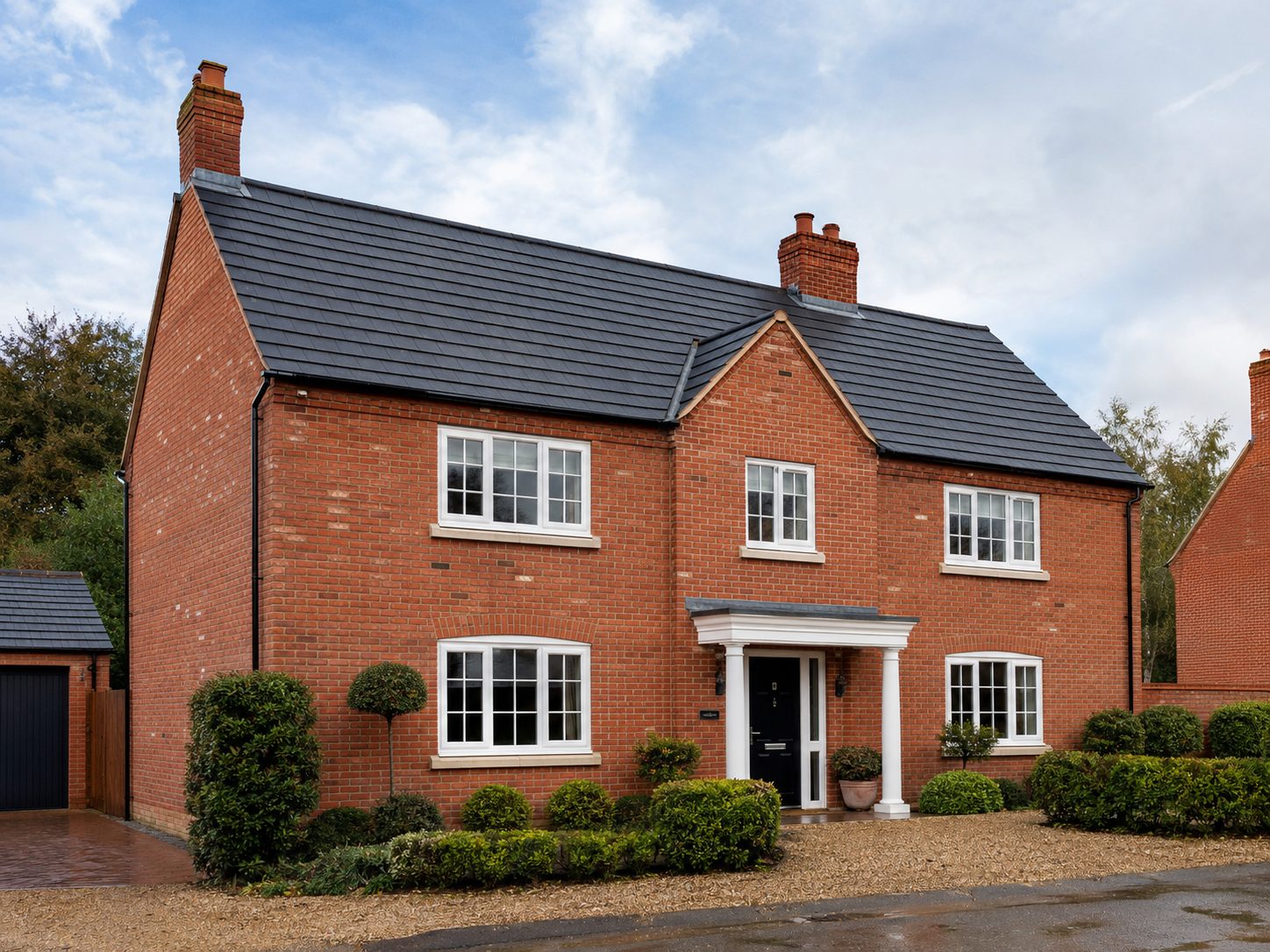
A roof survey is not a man glancing up from the pavement, and it is not a sales visit dressed up as an inspection. Done properly it is a systematic look at the covering, the structure, the junctions and the roof space, with photographs and a written description of what was found. This page explains what we look at, in what order, what a useful report says, and how a roofer's inspection differs from the roof section of a homebuyer survey.
Need this sorted?
Roof Repairs & Leaks from Larke's Roofs.
Before anyone gets on the roof
The survey starts on the ground with a full walk around the building. From here you get the geometry: how many slopes, where the hips and valleys run, where the chimneys sit, how the roof meets extensions and neighbouring properties, and where the water is supposed to go.
It is also where most of the obvious faults are visible with binoculars or a zoom lens: displaced units, gaps in ridge mortar, lifted lead, sagging gutters, staining down walls. Photographs are taken at this stage because they give context that close ups do not.
We will also ask you questions, and the answers matter. When did it first leak, in what weather, does it happen every time or only in wind from one direction, has anyone worked on it before. A leak that only occurs in driving rain from the south west tells you something very specific.
The loft
Where there is safe access, the loft is often more informative than the outside. From underneath you can see daylight through the covering, damp staining and its pattern, the condition of the underlay, rot at rafter feet and wall plates, and whether the insulation and ventilation are working with each other or against.
Staining patterns tell a story. A single stain directly below a chimney is different from a series of stains along a purlin, which is different again from uniform darkening across the whole underside of the boards. The first is a flashing, the second is water tracking, the third is condensation.
This is also where a roofer distinguishes a leak from condensation, which changes the recommendation completely and saves owners from paying for roof work that would not have solved anything.
Roof Repairs & Leaks
- Leak tracing and repair
- Slipped and broken tiles
- Storm damage repairs
The roof itself
Access is decided by the roof and the weather, not by convenience. Where it is safe to do so, we get onto the roof or use ladders and access equipment appropriate to the property. Where the covering is fragile, the pitch is severe or conditions are poor, we will not, and a survey that requires scaffold or a tower will be described as such.
On the roof, the assessment follows the order in which roofs actually fail: the junctions first, then the edges, then the field of the covering.
- Chimney flashings, aprons, soakers, back gutters and flaunching
- Abutments where the roof meets a wall or a neighbouring property
- Valleys and their linings, and any debris sitting in them
- Ridge, hips and verges, and the condition of any mortar bedding
- The field of the covering: slipped, cracked, delaminating or missing units
- Fixings, and on slate roofs the evidence of nail fatigue
- Gutters, fascias, soffits and outlets
- Flat areas: falls, ponding, laps, upstands and outlet details
What a useful report contains
The report should describe what was found and what it means, with photographs, and it should separate the urgent from the desirable. If it does not distinguish between what is causing the leak today and what would be prudent within five years, it is not much use for planning or for budgeting.
For insurance purposes the report needs to go further and state the likely cause, because that is the question the insurer is asking. Storm damage, wear, or a defect in previous work are three different findings with three different outcomes.
What a report should not contain is pressure. A recommendation for full replacement on a roof that needs a flashing renewed is a sales document, not a survey.
Roofer's inspection versus homebuyer survey
A homebuyer survey covers the whole property and is usually carried out from ground level without the surveyor going onto the roof or, sometimes, fully into the loft. Surveyors reasonably use cautious language and frequently recommend that a roofing contractor inspects further.
That recommendation is not a diagnosis. We are regularly asked to look at roofs described in alarming terms in a survey and find a sound covering that needs the ridge repointing, and occasionally the reverse.
If you are buying, a roofer's inspection before exchange is inexpensive relative to the transaction and gives you either peace of mind or a specific figure to negotiate with. We inspect free of charge and provide a written quotation for anything we find.
Want a professional to handle it?
Common questions
Do you charge for a roof inspection?
No. Inspection and a written quotation are free and there is no obligation to proceed. If we think the roof is fine as it is, we will tell you that too.
Do I need to be at home?
For the external inspection, not necessarily, though it is helpful. For a loft inspection someone needs to let us in, and the conversation about what you have observed and when is genuinely useful to the diagnosis.
Can you inspect a property I am buying?
Yes, with the current owner's permission for access. It is one of the more common requests we get, and a clear written account of the roof's condition is a strong position to negotiate from either way.
What if the weather is bad on the day?
Ground level and loft inspection can usually still go ahead, and heavy rain is sometimes helpful because it shows you exactly where water is entering. Getting onto the roof in high wind or on wet slates is not safe, so that part gets rescheduled.
Related services
Covering Norwich and Norfolk.