
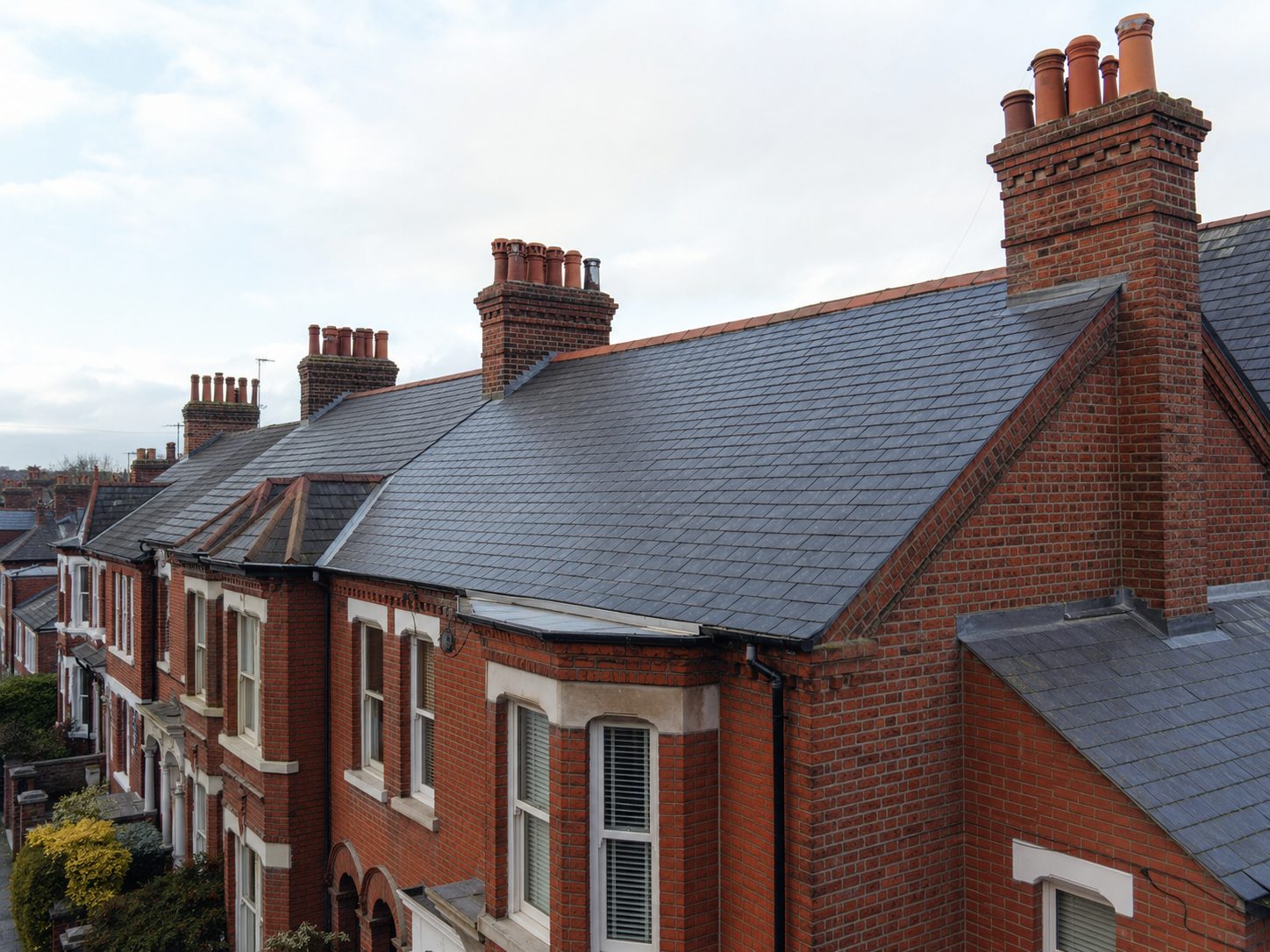
Slate is not one product. The difference between a top grade Welsh slate and a cheap imported one is far larger than most quotations suggest, and the price gap between them is real rather than a matter of branding. This guide sets out what actually differs, how slate quality is judged, where fibre cement fits in, and how to make a sensible decision for a Norfolk property rather than simply taking the top or bottom of the range.
Need this sorted?
Roof Replacement & New Roofs from Larke's Roofs.
Welsh slate
Welsh slate is the benchmark and has been for two centuries. It is dense, low in water absorption, splits cleanly and holds its colour, and there are Victorian roofs across the country still carrying their original Welsh slate with only the nails having failed.
It is also the most expensive option by a considerable margin, and it is heavy, which occasionally matters on an older or altered structure. Where it earns its money is on a property where longevity and appearance both matter, and where you have no intention of touching the roof again in your lifetime.
On listed and high value period properties in Norfolk, and anywhere the existing roof is Welsh slate, matching it is usually the right call regardless of the price difference.
Spanish slate
Spain supplies the majority of natural slate used in the UK, and it spans an enormous quality range. Good Spanish slate from a reputable quarry, correctly graded, performs very well and is what most domestic re-slating in this region uses.
Poor Spanish slate is where the trouble is. High carbonate content leads to slates that delaminate, rust stain or crumble at the fixing holes within a decade or two. Because it looks broadly similar when new, the only protection is knowing the source and the grade.
This is why we name the slate in our quotations. Slate is not a generic line item, and a quote that just says natural slate is not comparable with one that specifies quarry, grade and size.
- Ask for the quarry and the grade, not just the country
- Ask about the water absorption and carbonate figures
- Ask what thickness is being supplied
- Check whether the price includes copper or stainless fixings
Roof Replacement & New Roofs
- Full strip and re-roof
- Tile, slate and pantile coverings
- New battens, membrane and ventilation
Fibre cement slate
Fibre cement is a manufactured alternative: flat, uniform, lighter than natural slate and considerably cheaper. It suits budget conscious projects, outbuildings, and structures that cannot easily carry the weight of natural slate.
The trade offs are honesty about appearance and lifespan. It is perfectly regular, which is exactly why it does not look like natural slate at close quarters, and its expected service life is shorter than good natural slate. Some products are also prone to surface weathering that changes the colour unevenly.
On a listed building or in a conservation area, it will generally not be acceptable as a replacement for natural slate, so it is worth checking before it gets into a specification.
How the slates are fixed matters as much as the slate
A slate roof is a system, and the commonest reason for a Victorian slate roof failing is not the slate at all. It is nail fatigue, where the original iron nails have rusted through and slates begin sliding out one by one while the slate itself is still perfectly sound.
That is why the fixings specified matter. Copper or stainless nails outlast the roof rather than becoming its weak point, and the additional cost against galvanised is small in the context of the job.
- Copper or stainless steel nails rather than galvanised
- Correct head lap for the pitch and the exposure of the site
- Slate and a half units at verges rather than narrow cut pieces
- Lead soakers at abutments rather than mortar fillets
- Sound battens at the correct gauge, always renewed on a re-slate
Making the decision
If you own a period property where the roof is a defining feature, or you are matching existing Welsh slate, buy the best natural slate the budget allows. It will not need doing again.
If it is a standard house and you want a long, quiet service life at a sensible price, good graded Spanish slate from a named quarry is the pragmatic answer and is what most of our re-slates use.
If the building is a garage, an outbuilding or a rental where the priority is a sound weatherproof roof at the lowest sensible cost, fibre cement is a legitimate choice as long as you know what you are getting.
Want a professional to handle it?
Common questions
How long does a slate roof last?
Good natural slate has a very long service life and often outlasts its own fixings, which is why so many re-slating jobs reuse a proportion of the original slate. Fibre cement and lower grade imported slate have shorter expected lives, which is the main practical difference between the options.
Can my existing slates be reused?
Often, in part. We sort the stripped slate, keep the sound units and make up the shortfall with matching new material, usually putting the salvaged slate on the most visible slope. Whether it is worth doing depends on how many survive stripping, which we can estimate on inspection.
Is slate too heavy for my roof?
Most houses originally built with slate can carry slate again without difficulty. Care is needed where a roof was originally something lighter, or where the structure has been altered, in which case the timbers need assessing before the covering is chosen.
Why do slates start slipping all at once?
Because the nails are all the same age. Once iron nails begin to fail from corrosion, the rest are usually close behind, and patching individual slipped slates becomes a losing battle. At that point re-nailing or re-slating the slope is the economic answer.
Related services
Covering Norwich and Norfolk.