
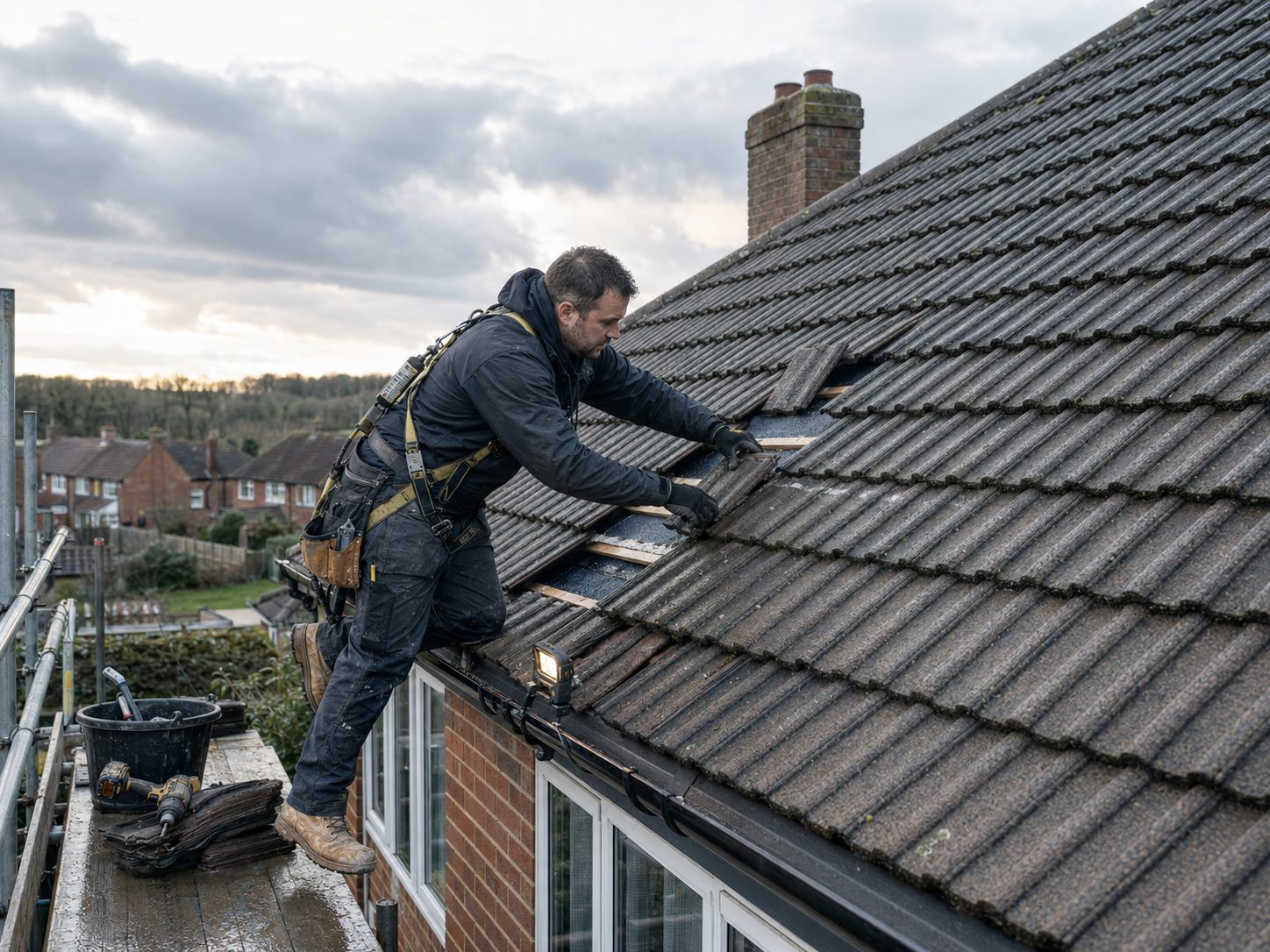
Almost every emergency call out we attend between November and February could have been prevented in September or October for a fraction of the cost and none of the stress. Roofs do not usually fail suddenly; they fail at the first serious test after a fault has been quietly developing. Autumn is when that fault is visible, accessible and cheap to fix. This is the checklist we would work through on our own houses, in the order we would do it.
Need this sorted?
Roof Repairs & Leaks from Larke's Roofs.
Clear the water paths first
Gutters, valleys, hopper heads and outlets are where autumn causes problems, and they are the single highest value thing to deal with. A gutter full of leaves overflows onto the wall in every heavy shower, and in a frost that saturated masonry spalls.
Valleys matter even more because a silted valley diverts water sideways under the covering rather than down the roof, and that produces leaks in places that look nothing like the actual fault. On a flat roof, one blocked outlet turns the whole area into a pond.
Do the clearing after the leaves have finished falling rather than in the middle of it, otherwise you will be doing it twice.
- Gutters cleared along their full length and flushed through
- Downpipes checked for blockage at the shoe and at any bend
- Valleys cleared of leaf silt and moss
- Flat roof outlets and any leaf guards cleared
- Gullies at ground level cleared so downpipes can discharge
Check the edges and the junctions
Wind uplift concentrates at the ridge, the hips and the verges, and those are the parts that give way in the first serious gale. Look along the ridge line for gaps, missing mortar or a tile sitting proud, and look at the verges at both gable ends.
Then the junctions: lead around chimneys, abutments where a lower roof meets a wall, and the upstands on any flat area. Lifted edges, rippling and visible sealant all indicate work that is coming, and it is a far smaller job in October than after it has let a winter's worth of water in.
Anything loose enough to move in the wind should be dealt with straight away regardless of whether it is currently leaking, because falling roof material is a safety issue as well as a roofing one.
Roof Repairs & Leaks
- Leak tracing and repair
- Slipped and broken tiles
- Storm damage repairs
Look in the loft
Ten minutes in the loft with a torch on a bright day tells you a great deal. Turn the light off and look for daylight coming through the covering: pinpricks tell you where units are missing or the underlay is torn.
Then look for staining on the timbers and the underside of the boards, feel whether the insulation is damp, and check the eaves are not blocked with insulation pushed hard into them. Check that any bathroom or kitchen extractor duct actually goes outside rather than terminating in the loft.
Finally, check the water tank and pipework are lagged. Frozen pipes in a well insulated cold loft are a genuine winter risk, and a burst up there does more damage than most roof leaks.
Deal with trees and moss
Branches touching the roof abrade the covering in wind and keep the slope permanently damp. Cutting them back before winter removes both problems and reduces the debris going into your gutters next autumn.
Moss should be removed carefully, by hand or with an appropriate treatment, rather than by pressure washing. Pressure washing strips the surface off concrete tiles, drives water under the laps and can dislodge units, and we see more damage from over enthusiastic cleaning than from the moss itself.
Book the small jobs now
If the autumn check turns up a slipped tile, a cracked flaunching, a lifted flashing or a section of failing ridge mortar, get it booked. Small repairs in settled weather are quick, and the diary in October is a great deal easier than the diary in the week after a named storm, when everyone in the county is ringing at once.
This is also the right moment to decide whether repeated repairs are still good value. If the same slope keeps failing in a different place each year, a proper conversation about recovering that slope makes more sense than another winter of patching.
We carry out inspections free of charge, and if the answer is that your roof is fine and needs nothing, that is a perfectly good outcome.
Want a professional to handle it?
Common questions
When is the best time to have roof work done?
Late spring through early autumn is easiest for larger work, because a stripped roof needs settled weather. Repairs happen year round, but booking them in autumn rather than waiting for winter means you choose the date instead of the weather choosing it for you.
Should I clear the gutters myself?
Only if you can do it safely from a properly footed ladder at low level, and never on your own on a two storey property. Ladder falls are one of the commonest serious domestic accidents, and gutter clearing is a low cost job to have done properly.
Is moss on the roof actually harmful?
It holds moisture against the covering, which accelerates frost damage, and it washes down into gutters and valleys and blocks them. It is worth removing, carefully. It is not usually an emergency.
Do you do pre-winter checks?
Yes. An inspection covers the covering, junctions, roofline and loft, and comes with photographs and a written account of anything we find. It is free and there is no obligation to have the work done.
Related services
Covering Norwich and Norfolk.