
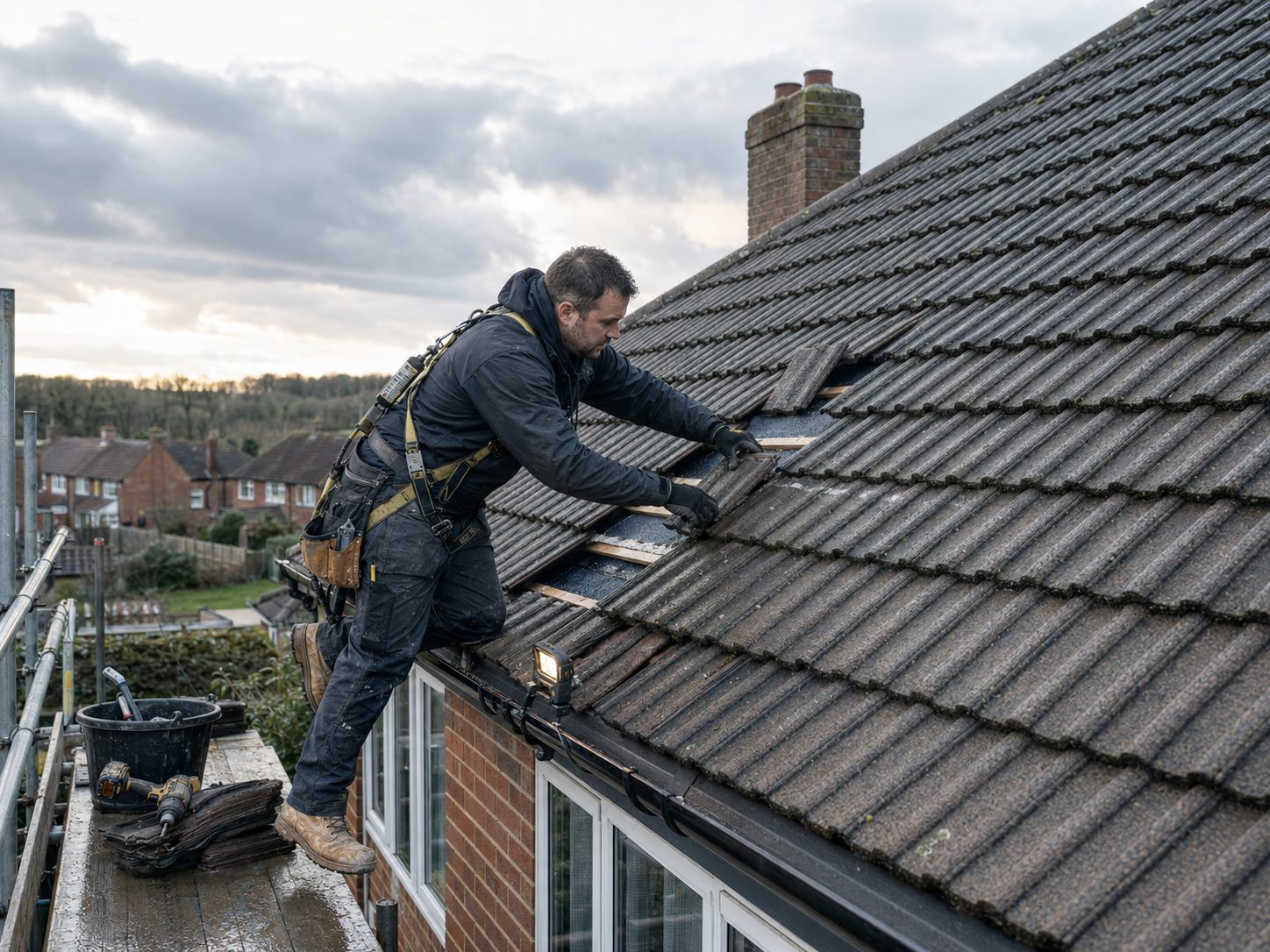
East Anglia takes weather from two directions and neither is kind to a roof. Winter systems come in hard off the North Sea along the coast from Cromer round to Great Yarmouth, and open, unsheltered inland country from the Brecks to the Fens gives wind a long clear run at exposed gables and ridge lines. After every serious blow we spend the following fortnight on the same handful of faults. This guide explains what those faults are, how to spot them from the ground, and how to decide what is urgent.
Need this sorted?
Roof Repairs & Leaks from Larke's Roofs.
What wind actually does to a roof
Wind does not simply push on a roof. As air accelerates over a ridge it creates suction on the leeward slope, and the strongest uplift occurs at edges: eaves, verges, hips and ridges. That is precisely why the damage is nearly always at a boundary of the roof rather than in the middle of a slope.
It also finds anything already loose. A mortar bed that had hairline cracks, a slate held by one tired nail, a lead flashing lifted at the top edge: none of those fail in ordinary weather, and all of them fail in a gale. In that sense a storm rarely creates a problem, it exposes one.
Driving rain adds the second half of the damage. Water pushed horizontally gets behind verges and under laps that would shed a vertical shower perfectly well.
How to check your roof safely from the ground
Do all of this from ground level, in daylight, and preferably with binoculars or a phone camera zoomed in. There is nothing on a roof worth climbing for the day after a storm.
- Walk the perimeter and look for fallen tiles, slate fragments or mortar on the ground
- Look along the ridge line for gaps, tilted ridge tiles or missing mortar
- Check the verges at the gable ends where the covering meets the wall
- Look for slipped, cracked or missing tiles and any daylight through the slope
- Check lead flashings around chimneys for lifting or rippling
- Look at gutters and fascias for sagging, splits or blockages
- Go into the loft in daylight and look for pinpricks of light or damp timber
Roof Repairs & Leaks
- Leak tracing and repair
- Slipped and broken tiles
- Storm damage repairs
What counts as urgent
Two things are urgent. The first is anything that could fall onto a person, a car or a public footpath: a hanging tile, a loose ridge, a detached section of fascia. That needs making safe today, regardless of whether the roof is leaking.
The second is active water ingress. Even a small entry point can soak insulation, saturate ceiling plasterboard and reach electrics within hours, so temporary weatherproofing is worth doing straight away even if the permanent repair has to wait for calmer weather.
Everything else, including cosmetic damage and single displaced tiles on a slope that is not leaking, can be scheduled properly rather than paid for at emergency rates.
Storm damage and insurance
Insurers distinguish between damage caused by a storm and damage caused by a roof that was already worn out. That distinction is where most disputes happen. Photographs taken immediately, the date and the name of the storm, and an independent description of the fault all help enormously.
Note that many policies define a storm by wind speed or by rainfall intensity, and that an insurer may reasonably decline a claim where the underlying cause was a mortar bed that had been failing for a decade. That is not a reason to avoid claiming, it is a reason to document properly.
We can carry out an inspection and provide a written report describing what we found and what caused it. What we will not do is describe damage as storm related when it plainly is not.
Reducing the damage next time
Most repeat storm damage is predictable. If the ridge is bedded in old sand and cement mortar, it will keep failing, and a dry fix mechanical ridge system removes that failure mode entirely. If the verges are mortared, the same applies. If the roof has slate on nails that are eighty years old, expect to keep losing slates until the slope is re-nailed or re-covered.
Gutters and overhanging trees are the other half of it. A blocked gutter overflows down the wall in exactly the weather that also stresses the roof, and a branch touching tiles in wind acts like a slow abrasive.
- Replace failing mortar ridge and verge with a mechanical dry fix system
- Have flashings checked rather than resealed year after year
- Clear gutters and valleys before autumn, not after the first storm
- Cut back branches that reach the roof line
- Have exposed coastal and gable end properties checked annually
Want a professional to handle it?
Common questions
How soon after a storm should I get the roof checked?
Within days if you can see anything displaced, and immediately if anything is loose enough to fall or water is coming in. Small faults that go unrepaired through a wet winter turn into rotten battens and wet insulation, which is a considerably larger bill.
Is one missing tile really a problem?
It can be. The membrane underneath is a secondary defence, not a roof covering, and once one unit is gone the neighbouring ones are exposed to uplift they were never meant to take alone. On a slate roof in particular, one lost slate is often the first of many.
Do you provide reports for insurers?
Yes. We inspect, photograph and set out in writing what we found and what caused it, which is what most insurers ask for. The inspection is free and there is no obligation to have us carry out the work.
Are coastal properties really worse?
Yes, noticeably. Wind driven salt accelerates corrosion of nails, clips and fixings, and exposure means the roof gets far more uplift cycles each winter. Roofs on the Norfolk coast generally need checking more often than the same roof would inland.
Related services
Covering Norwich and Norfolk.