
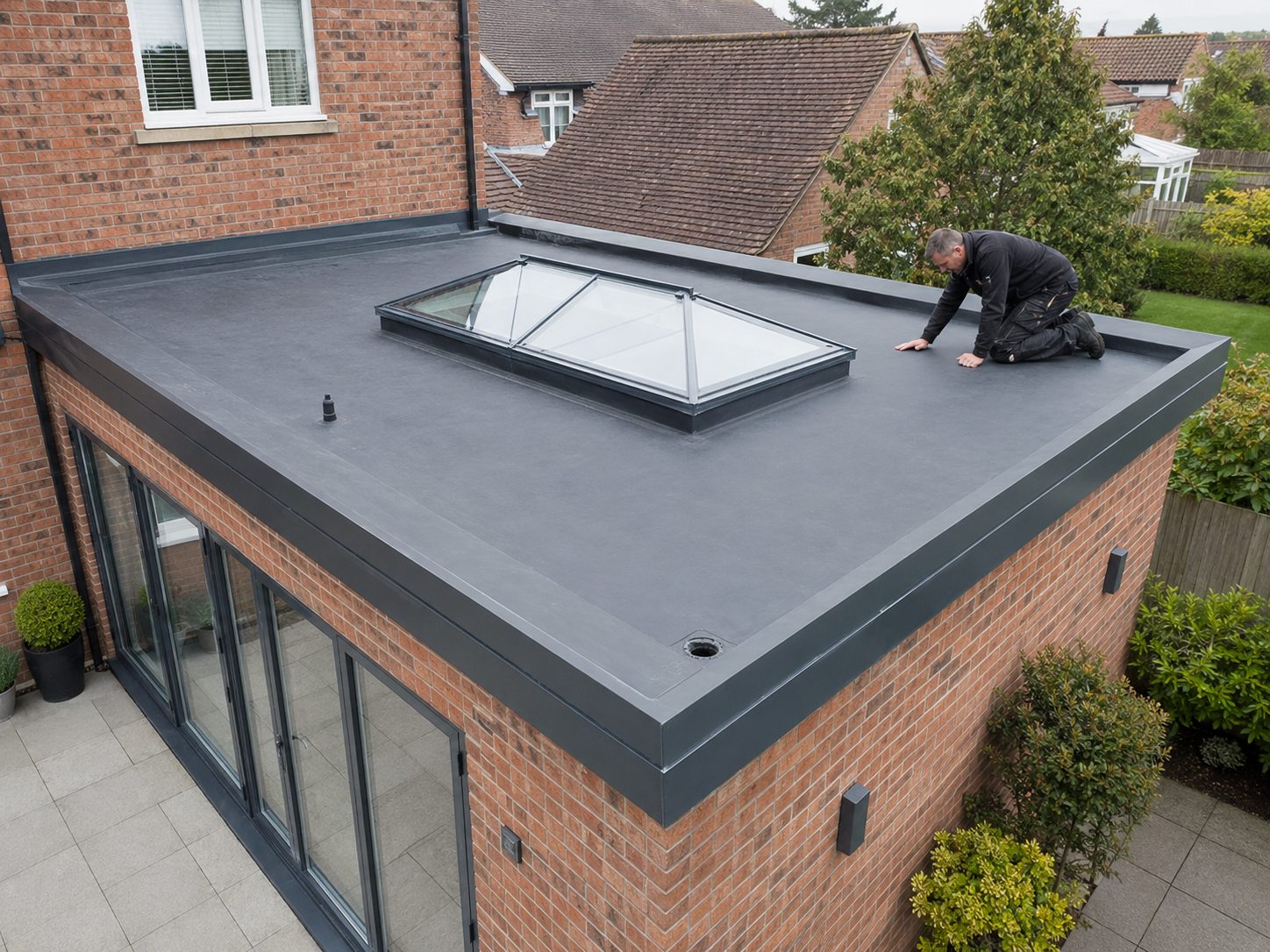
Felt carries the reputation earned by a single layer of mineral roofing felt nailed to a 1970s garage that split after eight winters. That product and the polyester reinforced built up systems we lay today have very little in common beyond the word bitumen. Built up felt remains the most widely used flat roofing material in the country, and on the right roof it is still the option we would specify ourselves. This guide explains how it is built, where it beats the alternatives, and how to read a felt quotation properly.
Need this sorted?
Flat Roofing & EPDM from Larke's Roofs.
Built up means layers, and the layers matter
A built up felt roof is a system, not a covering. The lowest layer, sometimes a perforated or venting underlay, controls how the roof is fixed and how any residual moisture in the deck can escape. The intermediate layer adds thickness and puncture resistance. The cap sheet on top carries the mineral finish that protects the bitumen from ultraviolet light.
That layered build up is why a modern felt roof is measured in decades rather than years, and it is why a quotation that says felt roof without saying how many layers tells you nothing. Two layer and three layer systems are different products at different prices.
Reinforcement is the other half of the story. Polyester carriers stretch and recover, so they cope with thermal movement in a way that the old glass fibre based felts never did.
Torch on, cold applied and self adhesive
Torch on is the traditional method: the underside of the membrane is melted with a gas torch and rolled into place, producing a fully bonded, fully sealed layer. It is fast and reliable in skilled hands, but it is hot work, and on timber decks, near eaves, around plastic rooflights and on occupied buildings it needs careful planning and a fire safe method.
Cold applied systems bond with adhesive rather than flame, which removes the hot work risk entirely. They are the natural choice over combustible substrates, on listed and heritage buildings, and where a building stays in use throughout.
Self adhesive membranes sit between the two and suit smaller domestic roofs. Whichever method is used, the laps are the part that matters, and a properly executed lap shows a small consistent bead of bitumen squeezed out along its length.
Flat Roofing & EPDM
- EPDM rubber roofs
- GRP fibreglass roofs
- Torch-on felt systems
Why felt still wins on complicated roofs
Sheet systems are at their best on simple rectangles. Felt is at its best where a roof is anything but: stepped upstands, multiple soil vents, a chimney breast passing through, a valley gutter behind a parapet, an awkward junction with a tiled slope.
Because it is dressed and bonded in place layer by layer, felt follows a shape that a single sheet has to be cut and patched to fit. Reinforcing pieces can be built into corners and internal angles before the cap sheet goes over them, so the most vulnerable points end up with the most material rather than the least.
It is also the easiest of the three to marry into existing work, which matters when you are recovering half a roof or joining a new extension to an older covering.
- Parapet and valley gutters behind walls
- Roofs with several penetrations and vent pipes
- Junctions between flat and pitched sections
- Phased work where new felt has to tie into old
What shortens a felt roof's life
Ponding is first. Water that never clears keeps the bitumen soft and works at the laps, which is why falls and outlet positions matter more on felt than the grade of the cap sheet.
Second is heat and light on unprotected bitumen. The mineral finish exists to shield the material, so a cap sheet that has lost its granules through scuffing, moss scraping or foot traffic is on borrowed time.
Third is movement at junctions with no allowance for it, and fourth is the classic false economy of laying a good cap sheet over a wet deck or wet insulation, which will blister no matter how good the felt is.
Maintenance that actually extends it
Clear the outlets and gutters twice a year, particularly under trees, because standing water is the main enemy. Brush off moss rather than scraping it, since scraping takes the mineral surface with it. Keep ladder feet and anything heavy off the covering in hot weather when the bitumen is soft.
Look along the laps and the upstands once a year rather than at the middle of the roof, since that is where failures start. A lap beginning to open is a cheap fix in year twelve and an expensive one in year fourteen.
Costs and what to check in a felt quotation
Felt is usually the most competitively priced of the three systems for a given area, and a two layer system will always undercut a three layer one. That difference is legitimate and it is worth knowing which you are being quoted.
The other variables are the deck, whether insulation is being added or replaced, the number of upstands and outlets, and access. As with any flat roof, correcting the falls costs money and is worth every penny on a roof that currently holds water.
Ask for the number of layers, the type of cap sheet, the application method, and how the upstands and outlets will be formed. Our written quotations set all four out, and both the inspection and the quotation are free.
Want it looked at? See our flat roof repairs and replacement across Norfolk.
Want a professional to handle it?
Common questions
How long does a modern felt roof last?
A correctly laid multi layer polyester reinforced system on a deck with proper falls is a long life covering measured in decades, not the handful of years people associate with old single layer garage felt.
Is torch on felt a fire risk on my house?
Hot work always carries risk, which is managed with the right method, protection at combustible details and checks afterwards. Where the risk is difficult to control, on heritage buildings or over timber, we use cold applied or self adhesive systems instead.
Can felt be laid over my old felt roof?
Only if the existing build up is dry, well bonded and sound, and any insulation below it is dry. Laying over a wet roof traps moisture that blisters the new cap sheet in the first warm spell.
Why is one felt quote much cheaper than another?
Usually because one is a two layer system and the other is three layers, or because one includes correcting the falls and renewing the deck and the other does not. Compare the specification, not the total.
Does a felt roof need a green mineral finish?
Cap sheets come in several mineral colours, and the choice is cosmetic rather than technical. What matters is that the granules stay on the roof, because they are protecting the bitumen underneath.
Related services
Covering Norwich and Norfolk.