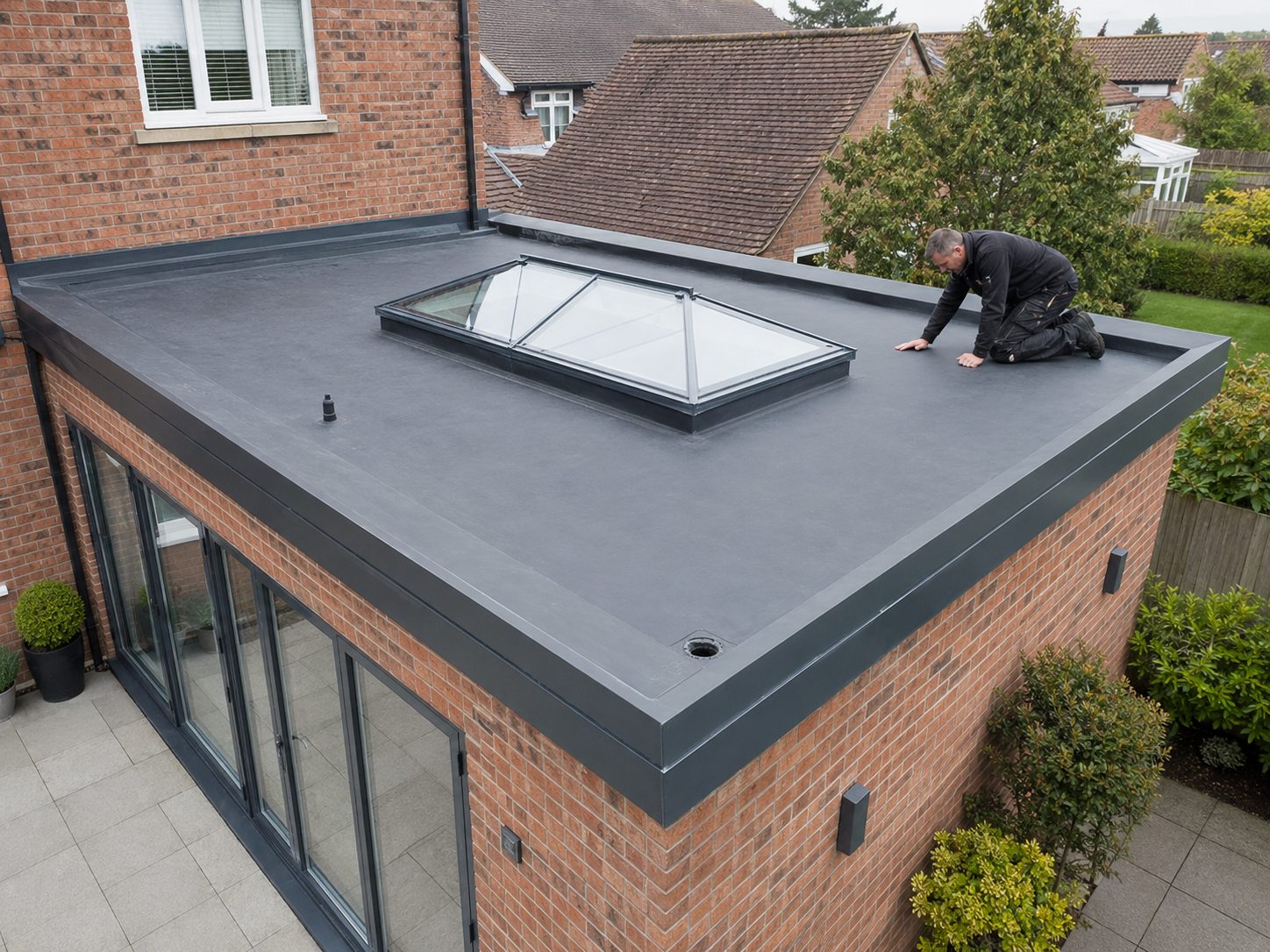
Most flat roof comparisons online are written by someone who only sells one system, which is why they all end the same way. We fit EPDM rubber, GRP fibreglass and built up felt, so the honest answer is that each of them is the best choice on some buildings and the wrong choice on others. What decides it is the shape of the roof, how much the structure moves, what will walk on it, how many awkward details it has, and how long you intend to keep the building.
Need this sorted?
Flat Roofing & EPDM from Larke's Roofs.
The one paragraph version
If the roof is a simple rectangle over a garage or extension and you want the least fuss, EPDM is usually the sensible pick. If it will take regular foot traffic or you want a hard, walkable, colour matched finish, GRP earns its place. If the roof is a complicated shape with lots of upstands, or it is over an occupied building where hot work needs careful handling, a modern torch on or cold applied felt system is often the most practical of the three.
How each system is actually built
EPDM is a synthetic rubber membrane, commonly 1.2mm or 1.5mm on domestic work, laid as a single sheet across the whole roof where the size allows. It is bonded to the deck with contact or water based adhesive, and the perimeters are trimmed into metal edge sections. On a typical garage or extension there are no seams at all in the field of the roof.
GRP is glass reinforced polyester built in place: a conditioned deck of OSB3 or ply, a layer of chopped strand mat, catalysed resin rolled through it to wet out the fibres, then a pigmented topcoat. The result is one continuous rigid laminate with the trims moulded into it.
Built up felt is two or three layers of reinforced bitumen membrane bonded in sequence, with a mineral surfaced cap sheet on top. Modern polyester reinforced systems bear little resemblance to the single layer felt on 1970s garages that gave the material its reputation.
Flat Roofing & EPDM
- EPDM rubber roofs
- GRP fibreglass roofs
- Torch-on felt systems
Movement, and why it decides more jobs than lifespan does
The main structural difference between the three is how they handle a deck that moves. Timber decks move with moisture and temperature, and older joists move more than new ones.
EPDM is elastomeric and can stretch substantially without damage, so it absorbs deck movement without complaint. That is why it does well on old garages with tired decks and on buildings where the structure is not perfectly stable.
GRP is rigid. It is exceptionally strong in the plane of the sheet but it does not stretch, so any significant movement in the boards below shows as a crack, usually along a board joint. That is why GRP is specified with a properly conditioned, correctly fixed deck and expansion detailing, and why a GRP roof laid over old, damp or springy boards is a problem waiting to happen.
Felt sits between the two. Its layers can accommodate modest movement, and it is the most forgiving of the three when a roof has an odd shape or a lot of junctions.
Foot traffic, terraces and rooflights
If the roof is purely weatherproofing that nobody stands on except a window cleaner, all three are fine. Once there is regular use, the picture changes.
GRP takes foot traffic better than anything else here and can be finished with a non slip aggregate, which makes it a natural choice for a balcony or a roof terrace. EPDM will take occasional traffic and can be walked for maintenance, but for a used terrace it wants a protective layer or paving on supports rather than being walked on directly. Felt with a mineral cap handles maintenance traffic well but scuffs under heavy daily use.
For rooflights and kerbs, GRP gives the neatest hard edge, EPDM handles the corner details cleanly with preformed pieces, and felt is dressed and welded around them.
- Occasional access only: any of the three
- Regular use or a terrace: GRP, or EPDM with a walkway or paving
- Lots of kerbs, pipes and upstands: felt or EPDM with preformed corners
Weather windows and installation practicalities
GRP needs dry conditions and a workable temperature range for the resin to cure properly, so a wet or cold week can push the job. EPDM needs the deck dry for the adhesive but is otherwise the least weather sensitive to lay. Felt needs dry conditions too, and torch applied systems involve hot work, which has to be planned carefully near timber, on occupied buildings and around anything combustible.
Small roofs are quick with all three. On a garage, a competent team is on and off in a day or two, most of which is deck preparation rather than the covering.
Repairability and what happens in year fifteen
This matters more than people expect. EPDM is repaired by cleaning, priming and bonding a patch, which is straightforward and permanent. GRP is repaired by grinding back and re-laminating, which is a good repair but needs dry conditions and skill to blend. Felt is repaired by cutting out and rebuilding the layers, which any competent roofer can do.
All three can be recovered at the end of their life, and none of them can be sensibly repaired if the insulation below has gone wet, which is the real end of life event on any flat roof regardless of the material on top.
So what would we recommend on your roof?
In practice the recommendation follows the inspection. We look at the deck, the falls, the outlets, the number of details, what the roof is used for, and what is above and below it. On a plain garage we most often fit EPDM. On a balcony or a roof someone walks on, GRP. On a complex or awkward roof over an occupied room, a modern felt system frequently gives the best result.
Whatever the recommendation, the quotation says which system, which thickness or number of layers, and how the details are formed, so you can compare it fairly against anyone else's.
Want it looked at? See our flat roof repairs and replacement across Norfolk.
Want a professional to handle it?
Common questions
Which of the three lasts longest?
Properly installed on a sound deck, all three are long life systems and the installation quality matters far more than the material. Every flat roof we see that failed early failed at a detail or over a bad deck, not because the wrong membrane was chosen.
Is EPDM better than fibreglass?
Neither is better in general. EPDM handles movement and awkward old decks better, fibreglass handles foot traffic and gives a harder finish. The building decides which advantage is worth more.
Is felt an outdated choice?
The single layer felt on old garages was, but modern polyester reinforced built up systems are a different product entirely and remain the most practical option on complicated roofs. Judging felt by a 1970s garage is like judging cars by a 1970s car.
Can I put a new system straight over the old flat roof?
Sometimes, if the existing build up is dry, sound and firmly fixed. If the insulation is wet or the deck is soft, overlaying seals the water in and the new covering will be blamed for the old roof's problem.
Do you fit all three, or recommend whichever you prefer?
We fit EPDM, GRP and felt, which is the only reason this comparison can be written honestly. The system we suggest is the one that suits the roof in front of us.
Can you upgrade the insulation at the same time?
Yes, and a recover is the natural moment to do it, because the covering is coming off anyway. It changes the roof height slightly, so the upstands, trims and any door thresholds are re-detailed as part of the work.
Related services
Covering Norwich and Norfolk.