
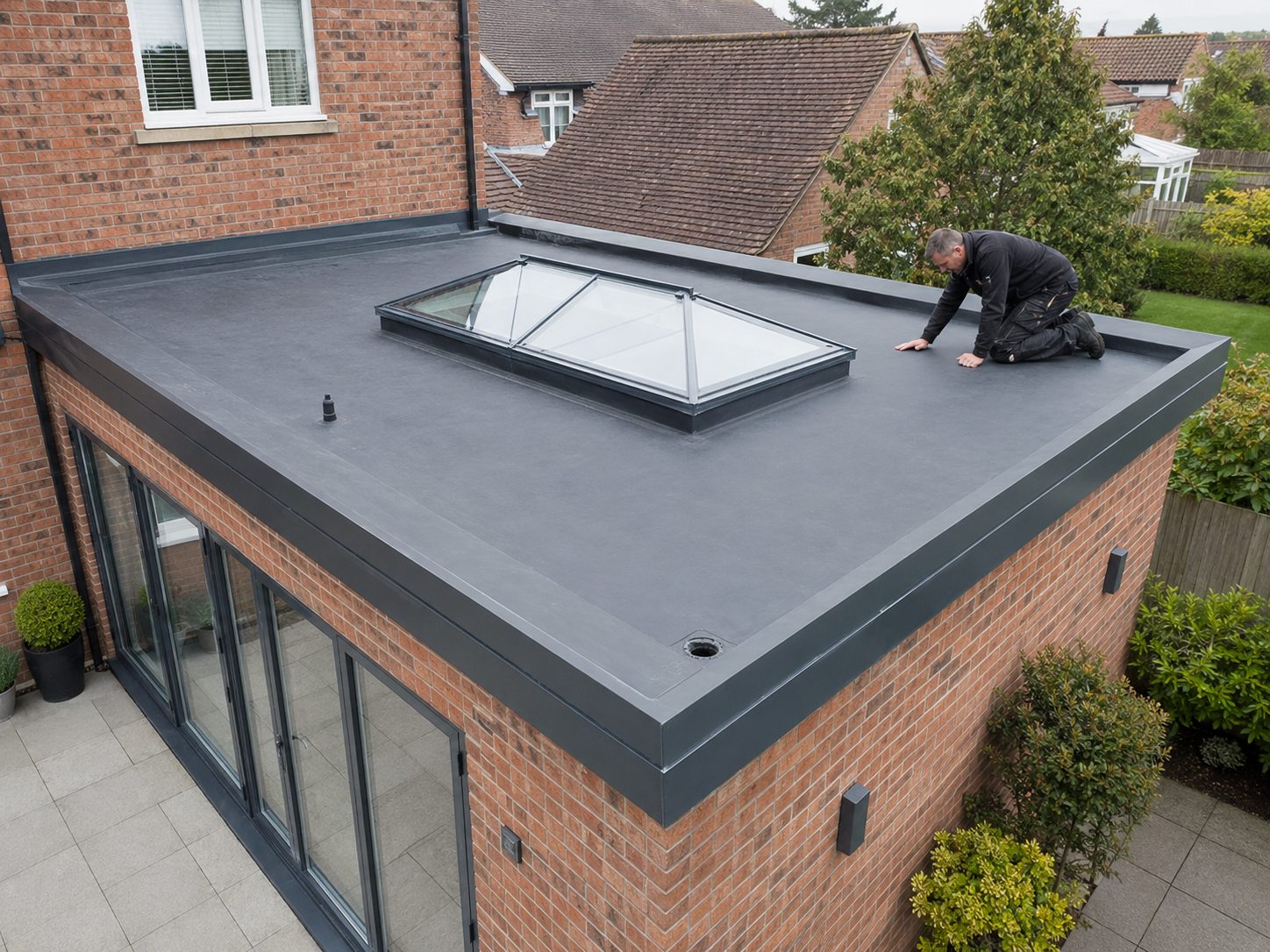
Almost nobody searches for flat roof repair out of curiosity. There is usually a damp patch on a ceiling, a drip into a garage, or water tracking down the inside of an extension wall after heavy rain. The useful thing to know early is that a leaking flat roof is not automatically a flat roof that needs replacing. Roughly speaking, faults fall into three groups: a defect at a detail, a defect in the field of the covering, and a covering that has simply reached the end of its life. The first two are repairable. The third is not, and no amount of sealant changes that.
Need this sorted?
Flat Roofing & EPDM from Larke's Roofs.
Start with where flat roofs leak, not where the stain is
Water entering a flat roof rarely appears indoors below the hole. It runs along the top of the deck or between layers until it meets a joist, a light fitting or a plasterboard joint, and that is where it drops. A ceiling stain a metre from the wall regularly turns out to be an upstand failure at the wall itself.
That is why the first job on a leaking flat roof is a proper look rather than a tube of sealant. We look at the perimeter trims and drips, the upstands where the roof meets a wall, the outlets and gutters, the laps between sheets or rolls, and any penetration such as a soil vent, aerial mast or rooflight kerb. In practice the field of the roof is the least likely place for water to get in.
- Upstands too low, or dressed short of 150mm above the finished surface
- Flashing chased into a wall and never re-pointed, so water runs behind it
- Outlets blocked with silt and moss, so the roof holds water above the lap line
- Splits at the corners where the covering was folded rather than cut and welded
- Perimeter trim lifted by wind, exposing the edge of the sheet
Felt, EPDM and fibreglass fail in different ways
On built up felt, the classic failures are lap opening as the bitumen loses its plasticity, blistering where trapped moisture expands in the sun, and cracking at movement points. Felt gives plenty of warning: the surface loses its mineral finish and goes grey and brittle long before it lets go.
On EPDM, the membrane itself is remarkably tolerant, so leaks nearly always come from the bonded joints, the corner patches, or a poorly formed outlet rather than the rubber. A single sheet EPDM roof with a leak in the middle of an unpenetrated field is unusual and normally means physical damage such as a dropped tool or a ladder foot.
On GRP fibreglass, failures show as hairline crazing, delamination from the deck where the substrate moved, and cracking along a joint in the boards below. Fibreglass is rigid, so it punishes any deck movement it was not detailed to accommodate.
Flat Roofing & EPDM
- EPDM rubber roofs
- GRP fibreglass roofs
- Torch-on felt systems
What each repair actually involves
A felt repair means cutting out the failed area back to sound material, drying it, and torching or cold bonding new layers in with generous overlaps, then reinstating the mineral surface. A blister is cut cross-wise, dried, dressed down and capped rather than simply painted over.
An EPDM repair is a clean, prime and patch operation using the same manufacturer's system: the area is scrubbed, primed and a patch bonded with taped or liquid joints and rolled to remove air. Done in dry conditions on a clean surface it is a permanent repair, not a holding measure.
A GRP repair means grinding back the crazed or delaminated area, keying the sound laminate around it, and laying new chopped strand mat and resin, then top coating so the finish matches. If the split is caused by movement in the deck below, the deck is fixed first or the crack simply returns in the same place.
When a repair is the wrong answer
There is a point where repairing is spending money to postpone. The clearest sign is wet insulation: if the boards under the covering are saturated, the roof will not dry out, the thermal performance is already gone, and patching the top seals the water in. You can usually tell by lifting a small area or by the deck feeling soft underfoot.
The others are widespread rather than local failure, a deck that has begun to sag or deflect between joists, and a covering with multiple previous repairs already on it. Three patches on a small garage roof normally means the fourth is not worth doing.
- Deck springy or soft when walked
- Water still appearing after two separate repairs at different points
- Covering crazed, brittle or blistered across most of the area
- Falls so poor that water sits for days and never clears
Making a leaking roof safe before the repair
If water is coming in today, clearing the outlets is the single most useful thing a homeowner can safely do from ground level with a hose or a rod, because a blocked outlet turns a small defect into a standing pond that finds every weakness. Do not go onto a wet flat roof: rubber and fibreglass in the rain are as slippery as ice, and older felt over a tired deck can give way.
Inside, move what you can, and pierce a bulging ceiling deliberately with a bowl underneath rather than letting it collapse in one go. Photograph everything before anything is cleaned up if you may be claiming on insurance.
We carry out emergency leak repairs and storm damage work, so if it is actively coming in the priority is stopping the ingress first and doing the considered repair afterwards.
What flat roof repairs tend to cost
As a general UK guide, a localised patch repair to a domestic garage or extension roof usually falls in the low hundreds of pounds, a set of detail repairs across upstands, outlets and trims runs into the mid hundreds, and once you are into the high hundreds or beyond you are close to the cost of recovering a small roof properly.
The factors that move the number are access and whether a scaffold or tower is needed, the height and the number of details, how much of the deck has to be opened up and dried, and whether insulation has to be replaced. Anyone quoting a firm price for a leak they have not stood on is guessing.
Inspections and written quotations are free, and if the honest answer is that a repair will not hold, we will say so rather than sell you one.
Want it looked at? See our flat roof repairs and replacement across Norfolk.
Want a professional to handle it?
Common questions
How long should a flat roof repair last?
A properly cut out and rebuilt repair on a sound deck behaves like the rest of the covering and lasts for years, not weeks. A repair over wet insulation or a moving deck will fail again in the same spot, which is why the cause matters more than the patch.
Can a flat roof be repaired in wet weather?
A temporary measure can be put on to stop water coming in, but felt, EPDM and GRP all need a dry, clean surface to bond properly. The permanent repair is booked for dry conditions, otherwise you are paying for something that will lift.
Why does my flat roof only leak in certain rain?
Wind driven rain gets behind upstands and trims that ordinary vertical rain never reaches, and heavy downpours overwhelm blocked outlets. A leak that only appears in a south westerly is usually telling you the fault is at a wall abutment on that side.
Is it worth patching an old felt roof or should I recover it?
If the felt is still flexible and the fault is at a detail, patch it. If the surface is grey, brittle and blistered across the whole area, a patch buys months. We will tell you which of the two you have when we inspect it.
Do you repair flat roofs someone else installed?
Yes. Most of the flat roof repairs we carry out are on coverings laid by others, including systems we did not install, and we will tell you if the original work is still within a manufacturer's cover you should be claiming under.
Related services
Covering Norwich and Norfolk.