
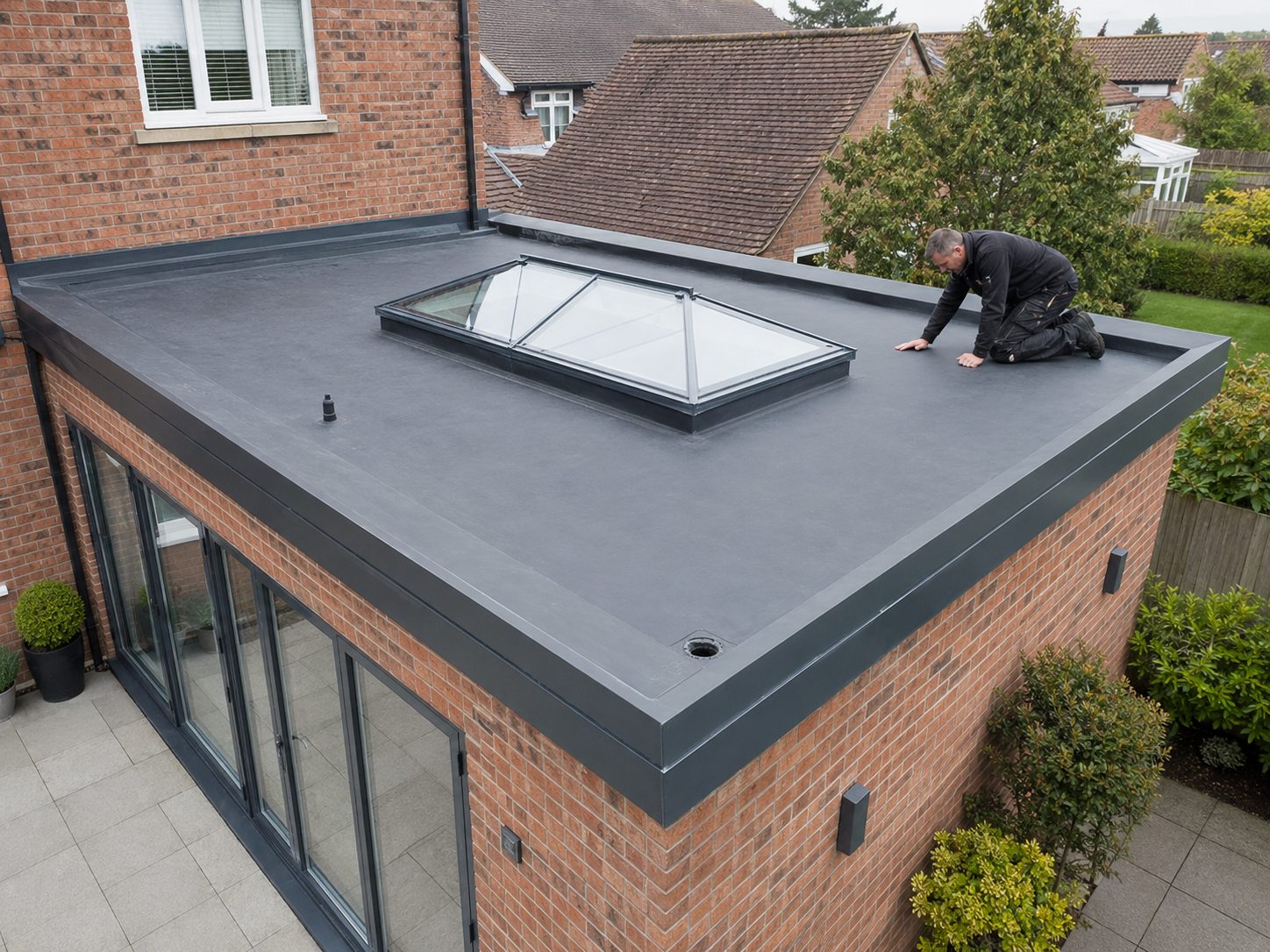
A GRP roof is not a sheet that gets rolled out. It is a laminate built in place on your roof, wet out by hand, and it ends up as one continuous piece of reinforced plastic with the edge trims chemically bonded into it. That is why a good one looks like a moulded tray and why a bad one shows every shortcut taken with the boards underneath. If you are considering fibreglass, the useful thing to understand is that the covering is only as good as the deck it is laminated to.
Need this sorted?
Flat Roofing & EPDM from Larke's Roofs.
How a fibreglass roof is actually built
The deck comes first. GRP is laid onto new boards, normally 18mm OSB3 or exterior grade ply, fixed with a deliberate expansion gap at the joints so the boards can move without stressing the laminate. Boards that are damp, dished, or fixed tight to one another are the single most common cause of a fibreglass roof cracking later.
Preformed GRP trims are then bonded and bandaged in at the eaves, drips and upstands. Chopped strand mat is laid over the whole deck and catalysed resin rolled through it until the glass goes translucent and every air bubble is worked out. Once cured, a pigmented topcoat is applied, and a non slip aggregate can be broadcast into it where the roof is walked on.
The result is a jointless surface with no laps to open, no adhesive line to fail, and trims that are part of the roof rather than fixed to it.
Where GRP genuinely outperforms the alternatives
Foot traffic is the obvious one. A fibreglass roof takes daily use, furniture on a terrace and ladder feet in a way a bonded rubber membrane does not, and it can be finished non slip for balconies and fire escape routes.
The second is the quality of edge and kerb detailing. Because the trims are laminated in, a GRP roof gives a crisp, hard arris at the drip and a properly moulded upstand around a rooflight kerb, which looks better and resists mechanical damage.
The third is finish. Topcoats come in a range of colours, so a dormer cheek or a visible balcony can be matched to the building rather than left black.
- Balconies and roof terraces in regular use
- Dormer roofs and cheeks visible from the ground
- Small complex areas where a moulded trim beats a folded one
- Porches, bay tops and canopies that see ladder traffic
Flat Roofing & EPDM
- EPDM rubber roofs
- GRP fibreglass roofs
- Torch-on felt systems
What goes wrong, and why
Nearly every failed GRP roof we are called to has one of four causes, and none of them is the resin.
Movement in the deck cracks the laminate along a board joint. Damp boards trap moisture that later drives blistering under the topcoat. Laminating in cold or wet conditions leaves an undercured, tacky or milky surface that never reaches full strength. And laminating straight over an old deck or an existing covering, rather than a new conditioned one, gives the laminate a substrate that is already moving and already wet.
The pattern to notice is that GRP is unforgiving of preparation. It rewards a roof that is built properly underneath and punishes one that is not, which is the opposite of EPDM's tolerance.
Living with a fibreglass roof
Maintenance is light. Keep the outlets clear, keep leaves out of the corners so they do not hold moisture against the laminate, and wash the surface occasionally if it is a walked on terrace. There is nothing to re-dress, re-bed or re-seal on an annual basis.
Over many years the topcoat can dull or chalk, particularly on south facing terraces, and it can be re-coated without touching the laminate below. That is a cosmetic job rather than a roofing one.
Damage from a dropped tool or a dragged ladder is repaired by grinding back to sound laminate, keying the edges, laying new mat and resin and re-coating. Done in dry conditions it is invisible and permanent.
What it costs and what moves the price
Fibreglass is generally the more expensive of the three flat roof systems on a like for like domestic roof, because a new deck is nearly always part of the job and the labour is skilled hand work rather than sheet laying.
The price moves with the deck: if the existing boards come off and the joists need attention or firrings need adding to correct the falls, that work is real and it is visible in the quotation. Access, the number of upstands and kerbs, insulation upgrades, and any non slip or colour matched finish all add to it.
The quotation should state the board specification, the weight of mat, the topcoat and whether a non slip finish is included. Ours does, and inspections and written quotations are free.
When we would talk you out of it
If the roof is a tired garage with a sound but slightly springy deck and you want the most cost effective long term covering, EPDM will do the job with less preparation and less risk. If the roof is a complicated shape with many junctions over an occupied room, a felt system is often easier to detail well.
GRP is worth its extra cost where the roof is walked on, visible, or needs hard moulded edges. Where none of those apply, we will say so.
Want it looked at? See our flat roof repairs and replacement across Norfolk.
Want a professional to handle it?
Common questions
Can fibreglass be laid over my existing flat roof?
It should not be. GRP wants a new, dry, correctly gapped deck to bond to, and laminating over an old covering or damp boards is the usual reason a fibreglass roof cracks or blisters within a few years.
Will a GRP roof crack in cold weather?
A correctly laid laminate on a properly gapped deck is stable through British winters. Cracking comes from deck movement or from resin that was applied in conditions too cold or damp for a full cure, not from frost on a sound roof.
Can I walk on a fibreglass roof?
Yes, that is one of its main advantages, and it can be finished with a non slip aggregate for balconies and terraces. Wet, smooth topcoat without aggregate is slippery, so tell us at quotation stage if the roof will be used.
How long does the installation take?
A typical domestic garage or extension roof is a couple of days including stripping and re-decking, with the resin needing dry conditions to cure. Bad weather delays it rather than being worked through, because a rushed cure is a poor roof.
Can the colour be matched to my building?
Topcoats come in a range of colours, which is useful on dormer cheeks and balconies that are visible from the street. The colour sits in the topcoat, so it can be refreshed later without disturbing the laminate.
Related services
Covering Norwich and Norfolk.