
A damp chimney breast is one of the few damp problems where the cause is nearly always above the ceiling rather than at floor level. A chimney is a masonry column standing proud of the roof, exposed on all four sides, with a hole down the middle. It gets more weather than any other part of the building and it has more ways of letting water in than any other part too. There are five realistic sources, and telling them apart is mostly a matter of where the stain is and what it looks like.
Need this sorted?
Roof Repairs & Leaks from Larke's Roofs.
Where on the breast is the damp?
Damp at ceiling level in an upstairs room, immediately below where the stack passes through the roof, points squarely at the flashings or at the stack masonry just above them. That is the most common of the five by a wide margin.
Damp spread over a large area of the breast, worse in humid weather, sometimes with a slightly sticky or crystalline surface, is usually salt contamination from years of combustion, not a live leak. Those salts pull moisture from the air, so the wall goes damp on a muggy day and dries on a dry one, regardless of rain.
Damp at the base of the breast, or on a ground floor with a bedroom above unaffected, is more likely to be a blocked or unventilated flue holding moisture, or in some houses a bridged damp proof course where the hearth meets the wall.
The flashings, which cause most of it
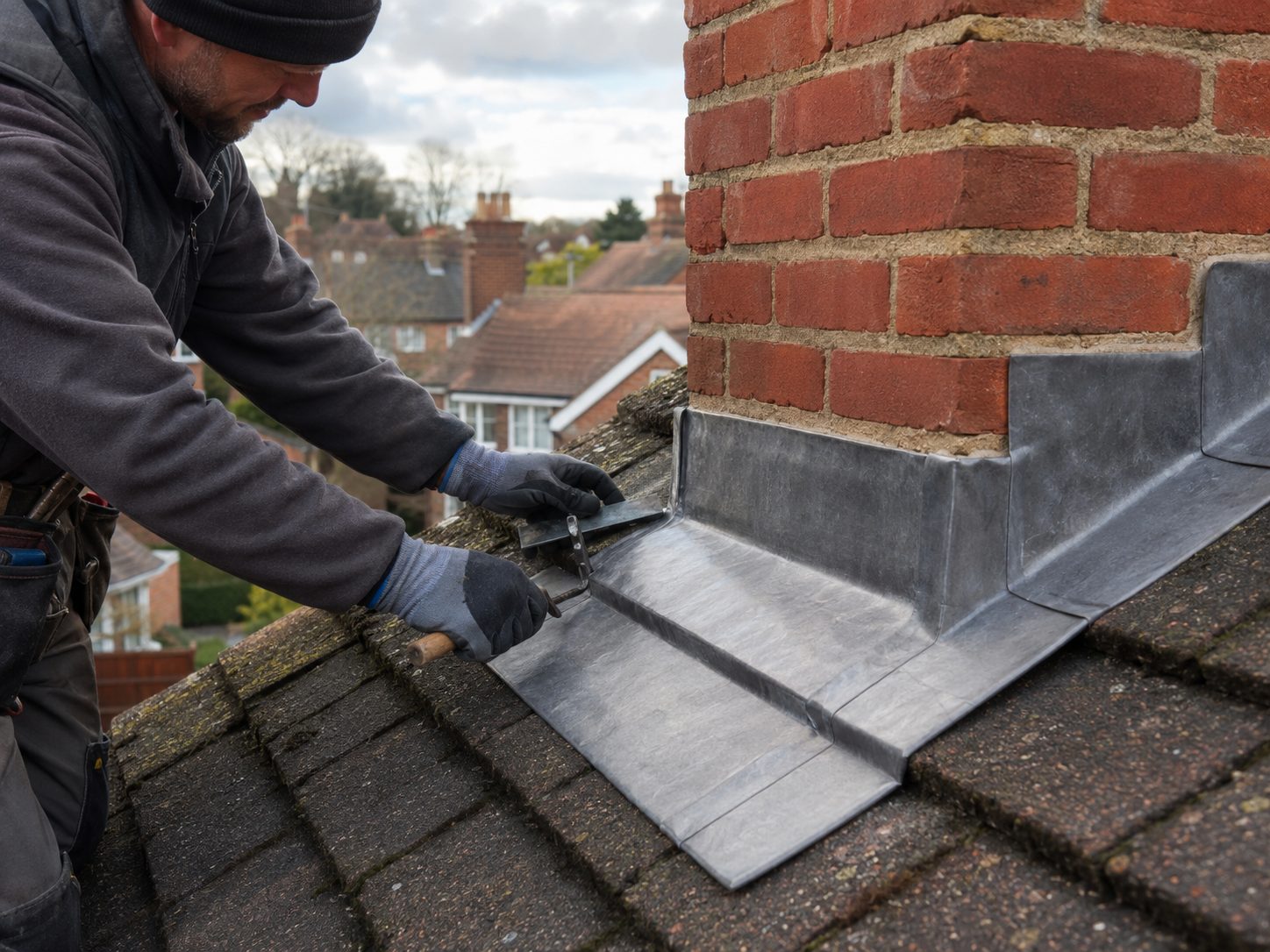
Where a stack passes through a roof, water is kept out by a set of lead pieces working together: a front apron, side soakers with a stepped cover flashing chased into the mortar joints, and a back gutter behind the stack. Every one of those is a separate opportunity for failure.
The back gutter is the one that catches people out. It sits on the uphill side of the stack, it collects everything the roof above sends down, and on shallow pitches and wide stacks it works hard. When it is undersized, laid without a fall, or blocked with moss and debris, water backs up over the upstand and into the roof.
The chased cover flashings are the second. Where the pointing that holds the lead into the brick joint has fallen out, the lead pulls away in wind and rain runs behind it. This is often visible from the ground on a bright day as a thin dark line along the stack.
- Mortar fillets instead of lead: a temporary detail that always cracks
- Back gutter full of moss and silt on a north facing slope
- Lead cover flashing loose because the pointing has gone
- Sheet lead cracked at regular intervals from thermal movement
Roof Repairs & Leaks
- Leak tracing and repair
- Slipped and broken tiles
- Storm damage repairs
The stack itself
Brickwork above the roof line takes wind driven rain from every side and has no protection at all. Once the pointing has weathered back, or the bricks have started to spall and lose their faces, the stack absorbs water like a sponge and delivers it downwards inside the structure.
The flaunching, which is the sloped mortar cap holding the pots, is another common failure. It cracks with age and frost, and rain then runs into the top of the stack instead of off it. Cracked flaunching is one of the easiest chimney faults to see with binoculars from the garden and one of the most worthwhile to fix early.
Pots and cowls matter too. An open pot on a disused flue is an open funnel, and while a chimney in use pulls warm air up which keeps things dry, a disused one simply collects rain.
The disused flue trap
The instinct with an unused chimney is to seal both ends. That is the wrong move. A capped and sealed flue with no airflow holds every bit of moisture that gets into the masonry, and the damp then shows on the breast inside the house.
The right approach is to keep rain out at the top while allowing air to move: a capped pot or a cowl that vents, plus a small ventilator at the bottom in the room or in the blocked fireplace. Air moving gently through the flue keeps it dry. This is a genuinely common cause of chimney breast damp in houses where an open fire was closed up decades ago.
What you can check before calling anyone
Look at the stack from the garden with binoculars on a clear day. Cracked flaunching, missing pointing, a leaning pot, a visible gap along a lead flashing and vegetation growing out of the brickwork are all identifiable from ground level.
Inside, note whether the damp changes with rain or with humidity, because that single observation separates a live leak from salt contamination and saves a lot of wasted work. Touch it: salts feel slightly gritty or sticky and often reappear through new paint within weeks.
Do not attempt anything on a stack yourself. Chimney work is at the highest point on a building, usually needs a scaffold, and stacks in poor condition are structurally unpredictable.
What the repairs involve
Renewing flashings means stripping the tiles back around the stack, forming new lead pieces in the correct sequence with soakers, stepped cover flashings, an apron and a properly sized back gutter, then chasing and re-pointing the lead into the joints and clipping it so wind cannot lift it.
Repairing the stack can mean re-pointing, cutting out and replacing spalled bricks, re-flaunching the cap, or in poor cases rebuilding the stack above the roof line. Where a chimney is redundant and beyond economical repair, removing it down to below roof level and making good the covering is sometimes the sensible answer.
Chimney repairs and leadwork are both services we offer, and the inspection and written quotation are free with no obligation.
Want a professional to handle it?
Common questions
How do I know if my damp chimney breast is a leak or old flue salts?
Watch the timing. Damp that darkens after rain and dries afterwards is a leak. Damp that comes and goes with humid weather regardless of rain, and that keeps returning through fresh paint, is usually salt contamination from years of use.
Should I seal up an unused chimney to stop the damp?
No. Sealing both ends traps moisture in the masonry and often makes the damp worse. Cap the top against rain but allow airflow, and fit a small ventilator at the bottom so the flue can dry.
Can flashings be repaired or do they need renewing?
It depends what is there. Sound lead that has pulled out of the joint can be re-dressed and re-pointed. Cracked lead, mortar fillets, undersized back gutters and short soakers need forming again properly.
Does chimney work always need scaffolding?
Anything more than a very minor repair usually does, because a stack sits at the highest point of the roof and needs safe working access all round. We set out whether scaffolding is included in the written quotation.
Is taking the chimney down an option?
On a redundant stack in poor condition, yes, it can be more economical than rebuilding. We would talk you through both options and price them, since it affects the appearance of the house as well as the cost.
Related services
Covering Norwich and Norfolk.