
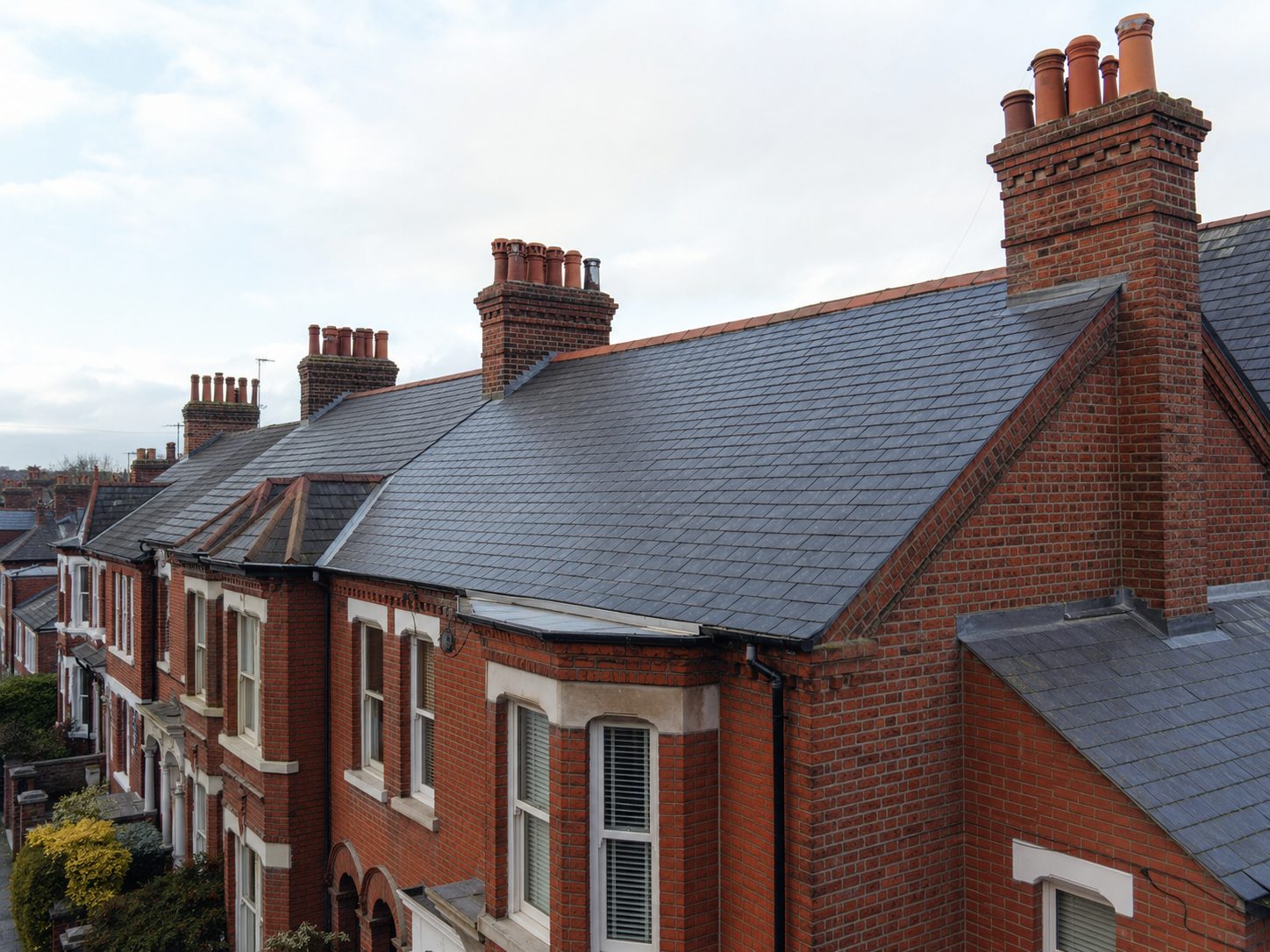
There is a specific and very common failure on older slate roofs where the slates themselves are in perfectly good condition but the nails holding them have rusted through. Roofers call it nail sickness. It matters because it changes the entire economics of the roof: replacing individual slipped slates on a nail sick roof is like patching a tyre that is losing air from the rim. Recognising it early lets you plan and budget rather than paying for a repair every time the wind gets up.
Need this sorted?
Roof Replacement & New Roofs from Larke's Roofs.
What nail sickness actually is
A slate is held by two nails driven through it into a batten, and each slate is also held down by the two courses above it. When those nails corrode and snap, the slate is no longer fixed. It stays put through friction and the weight of the slates above until a gust or a frost shifts it, and then it slides.
Traditional roofs were nailed with iron or mild steel, sometimes galvanised. Galvanising eventually wears through, particularly in a damp roof space or near the coast where salt accelerates it. Once one nail on a slate has gone the other carries double the load and follows.
Good natural slate outlives its fixings comfortably. That is why the roof of a Victorian house is often losing slates while the slates on the ground are still hard, ring true when tapped and could be relaid tomorrow.
How to tell nail sickness from ordinary slipped slates
One slate off after a storm, in the same place as a previous repair or next to a chimney, is a local fault. Slates coming off in different places on different elevations over one or two years is a fixings problem, and it will accelerate.
Look at the ones that come down. If a slate is intact with two clean holes and no cracks, and the nails are missing or a rusted stub is still in the batten, that is nail sickness. If the slate is cracked through a hole or delaminating into layers like a soggy book, the slate itself has failed and the story is different.
From the ground, a nail sick roof often looks slightly uneven before anything actually falls, because slates have crept down a few millimetres each. A line of slates sitting lower than their neighbours across a whole elevation is a warning worth acting on.
- Whole slates on the ground with clean holes: fixings
- Cracked or flaking slates: material failure
- Rust staining running down the face of slates: corroding nails
- Roof looking wavy or slates visibly crept: widespread movement
Roof Replacement & New Roofs
- Full strip and re-roof
- Tile, slate and pantile coverings
- New battens, membrane and ventilation
The trouble with patching
Individual slipped slates on a sound roof are refixed with a slate hook or a lead tingle, because the nail holes of the surrounding courses are covered and cannot be reached without lifting them. Both are perfectly acceptable repairs in the right context.
On a nail sick roof they become a treadmill. Each visit fixes the one that fell, while the hundreds either side are equally close to letting go. Owners often find themselves paying for two or three call outs a year, and the total over five years approaches the cost of doing the job once and properly.
There is also a hidden cost. Every slipped slate exposes the underlay, and old bituminous felt exposed to sunlight and rain deteriorates quickly. A roof that loses slates for several years usually ends up needing new underlay whatever else is done.
Stripping and relaying, and why it is often the answer
Where the slates are sound, the sensible course is to strip the roof, sort and keep the good slates, renew the battens and underlay, and relay the roof using non ferrous fixings, usually copper or stainless steel, which do not suffer the same corrosion.
It sounds drastic and it is a proper job with a scaffold, but the material cost is far lower than a new slate roof because most of the slate is reused, and the result is a roof with a full new life rather than a series of repairs. It also means the roof gains modern underlay and, where appropriate, proper ventilation, which the original never had.
Typically some percentage of the original slates will be broken or too far gone, and those are made up with matched second hand or new slates. That percentage is one of the things a proper inspection establishes, and it is one of the biggest factors in the price.
What to do in the meantime
Keep the ground below clear where you can, because a falling slate is genuinely dangerous, and check after every gale. Photograph and keep the slates that come down, since matching them later is easier with a sample in hand.
Where a slate has gone, the roof is not immediately going to leak, since the underlay is doing its job for now, but do not leave a hole through a whole winter. Get it covered.
We do carry out emergency repairs where a gap has opened up, and if it is urgent the number is 07437 005301.
Getting a straight answer on remaining life
An inspection for suspected nail sickness looks at the fixings rather than the surface. That means examining slates that have already come off, looking at the underside from the loft where the nail points and batten condition are visible, checking the underlay for deterioration and assessing how much of the slate is reusable.
From that we can tell you honestly whether you are looking at spot repairs for another few years or a strip and relay, and roughly when. Inspections are free and the written quotation carries no obligation, which means you can get the answer without committing to the work.
Want a professional to handle it?
Common questions
What is nail sickness on a slate roof?
It is when the nails holding the slates have corroded and failed while the slates themselves are still sound. Slates then slip one by one because nothing is fixing them, even though there is nothing wrong with the slate.
Can nail sickness be repaired without stripping the roof?
Individual slates can be refixed with hooks or lead tingles, and that is worthwhile while only a few are moving. Once slates are slipping regularly across different parts of the roof, repairs become a running cost rather than a fix.
Will my existing slates be reusable?
Often a large proportion are, particularly good natural slate that is still hard and unlaminated. A survey establishes roughly what percentage will need replacing, and that has a real effect on the cost of relaying.
Does living near the coast make it worse?
Salt laden air accelerates corrosion, which is one reason non ferrous fixings such as stainless steel or copper are worth specifying on exposed and coastal roofs when a roof is relaid.
How do I know it is not the slates that are failing?
Look at what lands on the ground. Whole slates with clean nail holes point to fixings. Slates that are cracked through the holes or flaking apart in layers point to the slate itself reaching the end of its life.
Related services
Covering Norwich and Norfolk.