
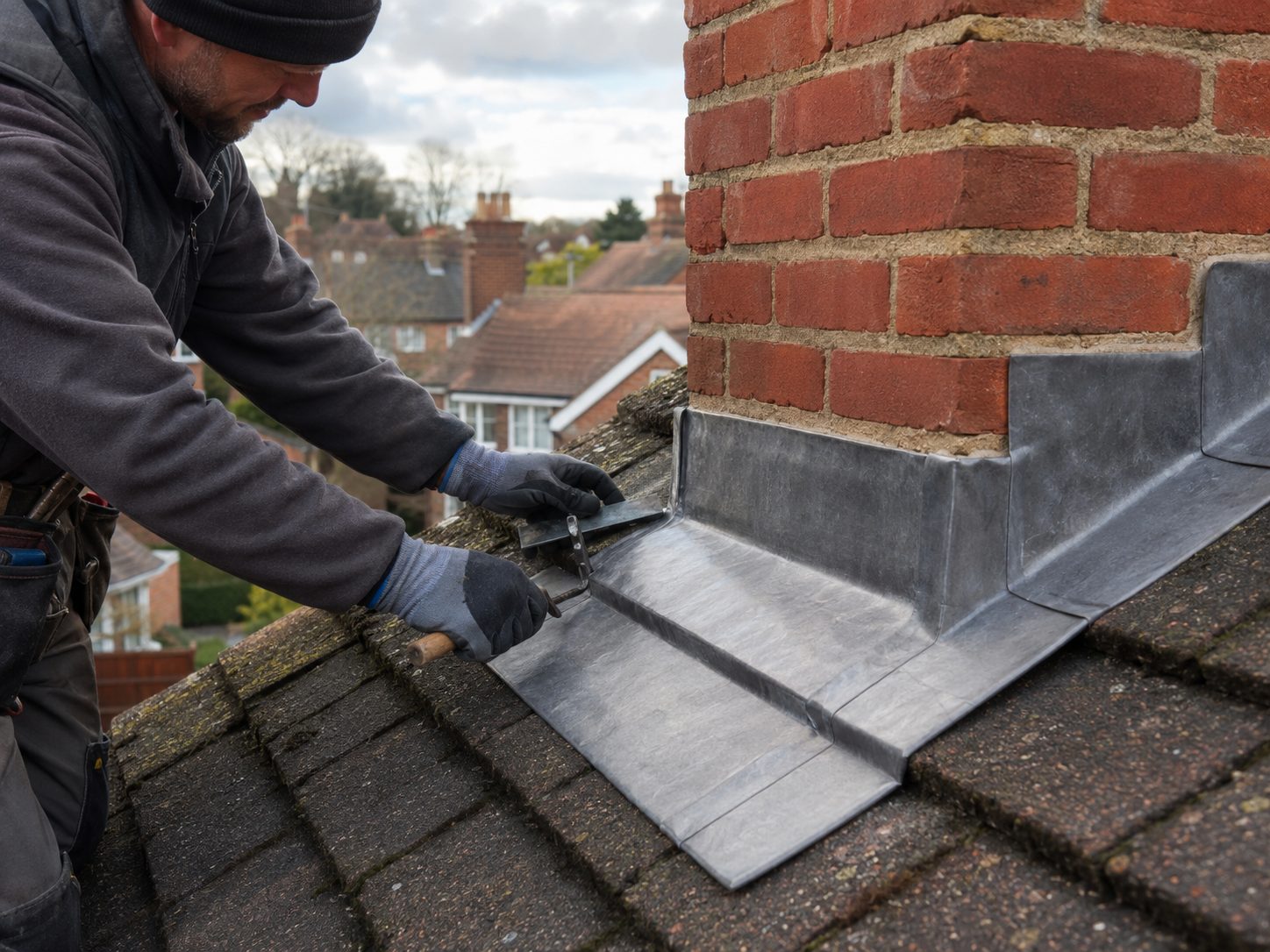
Porch canopies and bay window roofs are the smallest roofs on most houses and they cause an unreasonable number of problems. They are small enough that people assume the fix must be trivial, they are usually built tight against a wall, and they were very often added later by someone whose main trade was not roofing. Almost all of the water gets in at one place, which is the junction with the house wall, and almost none of it comes through the middle of the covering.
Need this sorted?
Roof Repairs & Leaks from Larke's Roofs.
The abutment is where the money is
Where a small roof meets a wall, water running down that wall in rain has to be intercepted and directed onto the roof covering, not behind it. That is done with a lead flashing chased into a mortar joint, turned down over the upstand of the roof covering and clipped so wind cannot lift it.
What we find instead, on porch and bay roofs particularly, is a mortar fillet troweled into the angle. It looks tidy for a couple of years and then it cracks, because brick and roof covering expand at different rates and mortar has no give in it at all. Once it cracks, it holds the water in the crack rather than shedding it, which is worse than nothing.
The other frequent find is a lead flashing simply resting against the wall and sealed with mastic. Mastic is a maintenance material with a life of a few years in direct sunlight, not a weathering detail.
Bay roofs have corners, and corners split
A square bay has two external corners. A canted bay has two more shallow ones. On lead or felt, corners are where the material is asked to do the most work, and if the corner was formed by folding rather than being cut and joined properly, the fold becomes a stress point.
Bay roofs are also frequently built with almost no fall, since the depth available between the window head and the sill of the window above is tiny. Water then sits on the covering rather than leaving it, and standing water on a badly formed corner is a reliable leak.
- Splits at a corner where the covering was folded
- Flat as a table, so water never clears
- Front edge with no drip, so water runs back under the covering
- Lead sheets too long, cracking from thermal movement
Roof Repairs & Leaks
- Leak tracing and repair
- Slipped and broken tiles
- Storm damage repairs
Where the damp shows up, and why it misleads
Water entering at a bay abutment usually appears inside as damp at the top of the bay window reveal, or as a stain on the ceiling of the room above rather than the room below. On a porch it appears above the front door frame, or as blown plaster in the hall.
That gap between cause and symptom is why porch and bay leaks are sometimes misdiagnosed as rising damp, condensation or a window seal fault. If damp appears above a small roof after rain and dries between rain events, the small roof is the first place to look.
Tiled porch canopies are a different animal
Some porches are tiled miniature pitched roofs. They leak for their own reasons: too few courses to get proper lap on a very short slope, verges bedded in mortar that has fallen out, and a covering laid at a pitch below the minimum the tile was designed for.
Pitch is the one that cannot be fixed with sealant. Every tile and slate has a minimum recommended pitch, and a tile laid too shallow will let wind driven rain travel up between the courses no matter how well it is fixed. Where that is the cause, the honest answer is to change the covering to something suited to a low pitch rather than to keep repairing it.
What a lasting repair looks like
For a flat porch or bay roof, that means cutting a proper chase into the mortar joint, forming a new lead cover flashing in correctly sized pieces, wedging and pointing it in, clipping the free edge, and making sure the covering below it has a genuine upstand behind the flashing rather than a turned up edge held by hope.
It also means checking the fall and the front edge. Where a bay roof has no fall at all, building in a slight fall during a recover is a small extra cost that makes a large difference to how long the covering lasts.
Because these roofs are small, the work itself is usually quick. Access is the variable: a ground floor bay may need nothing more than a tower, while a first floor bay or a porch under an overhanging eaves may need something more. We set that out in the written quotation.
Worth doing at the same time
While the covering is off, it is worth checking the timber below it, because these small roofs are frequently built with light decking that has been quietly wet for years. Replacing a small area of deck at that point costs very little and avoids doing the job twice.
It is also the moment to sort the rainwater. A porch or bay roof that discharges straight onto a path or against the wall below is soaking the masonry every time it rains, and a small outlet and downpipe fitted during the repair usually pays for itself in avoided damp.
Inspections and written quotations are free and carry no obligation, so you can find out whether it is a flashing job or a recover before deciding.
Want it looked at? See our flat roof repairs and replacement across Norfolk.
Want a professional to handle it?
Common questions
Why does damp appear above my bay window rather than below the roof?
Because water entering at the abutment runs along the top of the covering or inside the structure before it finds a way in. On bays it commonly tracks into the wall head and shows above the window reveal or in the room above.
Can the mortar fillet just be repaired?
It can be re-formed, but it will crack again for the same reason it cracked the first time. A lead flashing chased into the mortar joint is the detail that lasts, and on a small roof the difference in cost is modest.
My porch roof is tiled and very shallow. Can it be made watertight?
If the pitch is below the minimum for the tile, no amount of refixing will hold in driving rain. In that case the practical answer is to change the covering for a system designed to work at a low pitch.
Do these small roofs need scaffolding?
A ground floor porch or bay can often be reached with a tower or a small platform. Anything higher, or anything under an overhang, may need more, and we say clearly which in the quotation.
Is it worth recovering a bay roof rather than repairing it?
If the covering is old, has no fall and has been patched before, recovering a small area is often cheaper over time than a further repair, and it lets the fall and the edge details be corrected properly.
Related services
Covering Norwich and Norfolk.