
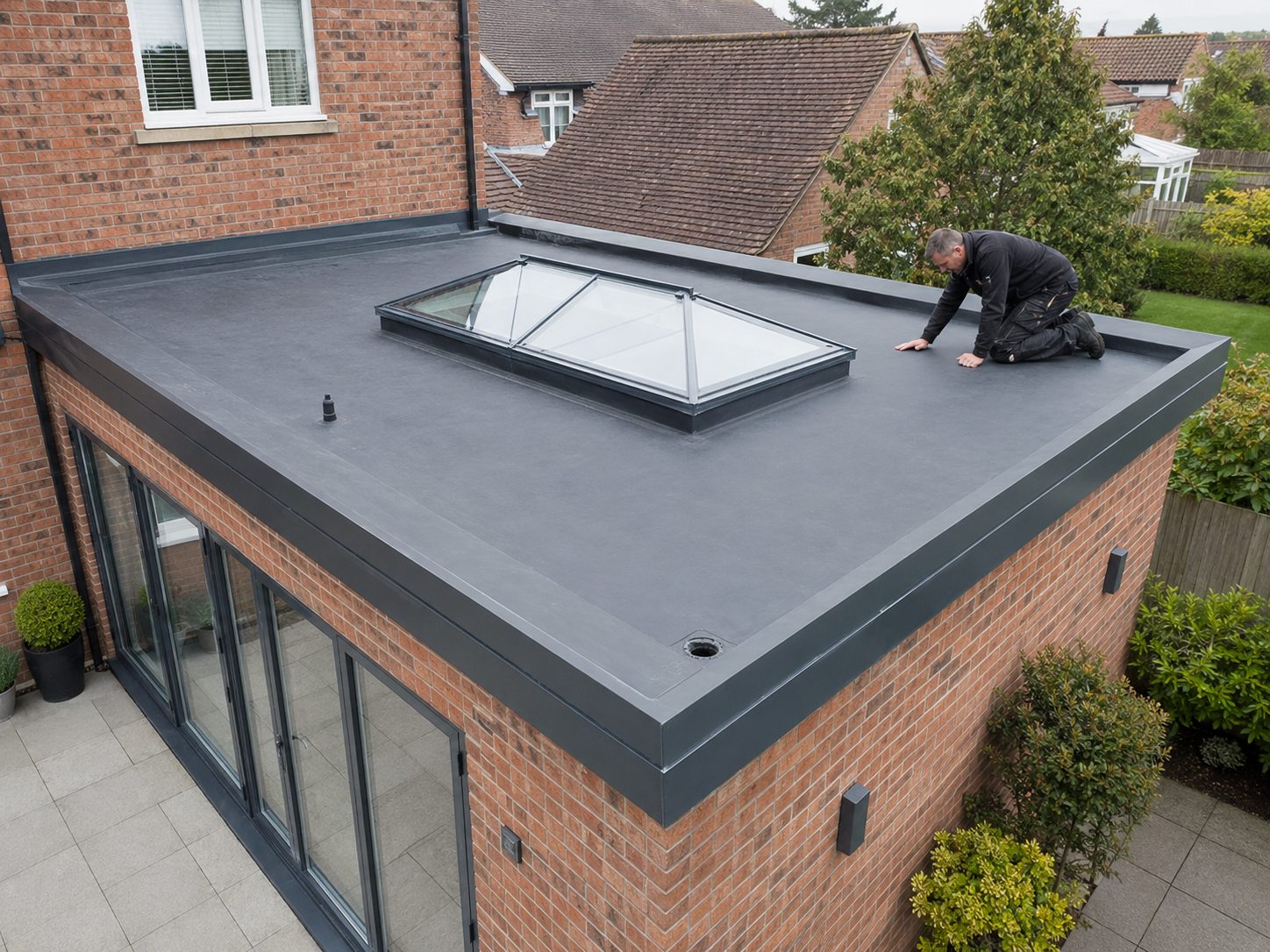
Felt cracks because bitumen ages. It is a flexible material held flexible by oils that slowly leave it under ultraviolet light and heat, and once enough of them have gone the sheet becomes a brittle board that can no longer move with the deck underneath it. Every felt roof does this eventually. The useful question is not whether it is cracking, but what kind of cracking it is, because fine surface crazing on an otherwise sound roof and a clean split across a joint line are two entirely different problems with two entirely different prices.
Need this sorted?
Flat Roofing & EPDM from Larke's Roofs.
Three kinds of cracking, three different meanings
Crazing is a fine network of shallow lines across the surface, like the glaze on old pottery. It tells you the cap sheet has hardened and lost the mineral finish that was protecting it. On its own it is not a leak, but it is a countdown, because rain now sits directly on the bitumen and frost gets into every line.
A split is a single line, often surprisingly straight, and it is a structural message rather than a wear message. Felt splits where something below it moves and the felt is no longer flexible enough to absorb it, so straight splits usually run along a joint in the deck boards, across a change of substrate, or over a joist.
A star or a crescent shaped crack is usually mechanical. Something was dropped, a ladder foot was planted, or a blister was walked on when the roof was cold and the skin gave way.
Why felt splits along a line
Timber decks move. Boards expand and shrink with moisture, chipboard swells at its edges, and any deck fixed to joists moves as the building warms and cools. A new felt system copes with that easily. A twenty year old one cannot.
The most common line of failure is directly over a deck board joint, and it is the reason a good recover includes checking the deck and using an isolating or partially bonded first layer rather than sticking everything solidly to a substrate that is going to move. If a split is simply patched and the movement below is left, the patch survives a season or two and then the split reappears alongside it.
- Split following a straight line: deck joint or substrate change
- Split at a corner or upstand: folded rather than cut and welded detail
- Repeated split in the same place: movement, not material failure
- Crack with felt curling upwards at the edges: badly shrunk, near end of life
Flat Roofing & EPDM
- EPDM rubber roofs
- GRP fibreglass roofs
- Torch-on felt systems
Shrinkage, and why the edges tell you the most
As felt ages it shrinks slightly. On a small roof this pulls the covering away from the perimeter trims and up the upstands, which is why the first evidence of a genuinely old felt roof is often at the wall abutment, where the felt has crept downwards and left the top edge hanging free behind the flashing.
Look at the corners as well. A corner that has been formed by folding rather than cutting will hold a stress point for its whole life, and it is nearly always the first place a genuinely old roof splits.
Why the tin of paint on coating usually disappoints
Liquid coatings sold as an answer to a cracked felt roof do work in specific circumstances: a clean, dry, sound surface, correctly primed, applied at the right thickness in the right weather. Applied over a damp roof, a dirty roof, or a roof that is cracking because the deck moves, they fail quickly and often make matters worse, because a coating that has trapped water underneath it hides the wet area from view.
The other issue is that a coating cannot restore a felt roof that has already shrunk away from its details. The details are where the water is getting in, and painting over them does not rebuild them.
Judging what is left
A useful test on a dry day is to press the surface with a thumb and see whether it gives slightly or feels like a board. Bitumen that still yields has life in it. Bitumen that is rigid and cold to the touch is finished.
The second test is underfoot. A firm deck with a hard covering can be recovered without touching the structure. A deck that flexes, feels soft or sounds hollow has been wet for a long time, and that changes both the job and the price. Wet insulation and a soft deck are not repairable by anything laid on top.
The third is history. Two patches is a repair. Five patches is a roof telling you something.
What we do about it
Where the roof is sound and cracking is local, we cut out the failed area back to good material, dry it, rebuild the layers with generous overlaps and reinstate the surface so the repair sits flush rather than proud.
Where the felt has reached the end, we strip and recover, and that is the sensible moment to look at whether felt is still the right choice for that roof or whether EPDM rubber or fibreglass suits it better given the falls, the details and how much foot traffic it takes.
Either way the inspection is free and the written quotation carries no obligation, so you can find out which of the two you are looking at before you commit to anything.
Want it looked at? See our flat roof repairs and replacement across Norfolk.
Want a professional to handle it?
Common questions
Can a cracked felt roof be repaired, or does it all have to come off?
Local cracking on a roof that is otherwise sound is repaired by cutting out and rebuilding that area. Cracking across the whole surface, or a covering that has gone rigid and shrunk from its details, is past repair and needs recovering.
Why does the same crack keep coming back after repairs?
Because the cause is movement in the deck below rather than the felt itself. Until the deck joint or substrate movement is dealt with, any patch laid across it is put under the same stress that split the original.
Is a liquid coating a reasonable way to buy a few more years?
Only on a clean, dry, structurally sound roof applied in suitable weather. On a damp or moving roof it fails early, and it hides wet areas from view, which makes the eventual job harder to price and to put right.
How long should a felt flat roof last?
It varies a great deal with the grade of felt used, how well it was laid, how good the falls are and how exposed the roof is. Rather than quote a single figure, we look at the surface condition, the details and the deck to judge what is left in a specific roof.
Would you replace felt with felt?
Sometimes, yes. Modern torch on systems are a long way from cheap mineral felt and can be the right answer, particularly on larger or complex roofs. On small domestic roofs we often talk through EPDM or fibreglass as well, and explain the differences honestly.
Related services
Covering Norwich and Norfolk.