
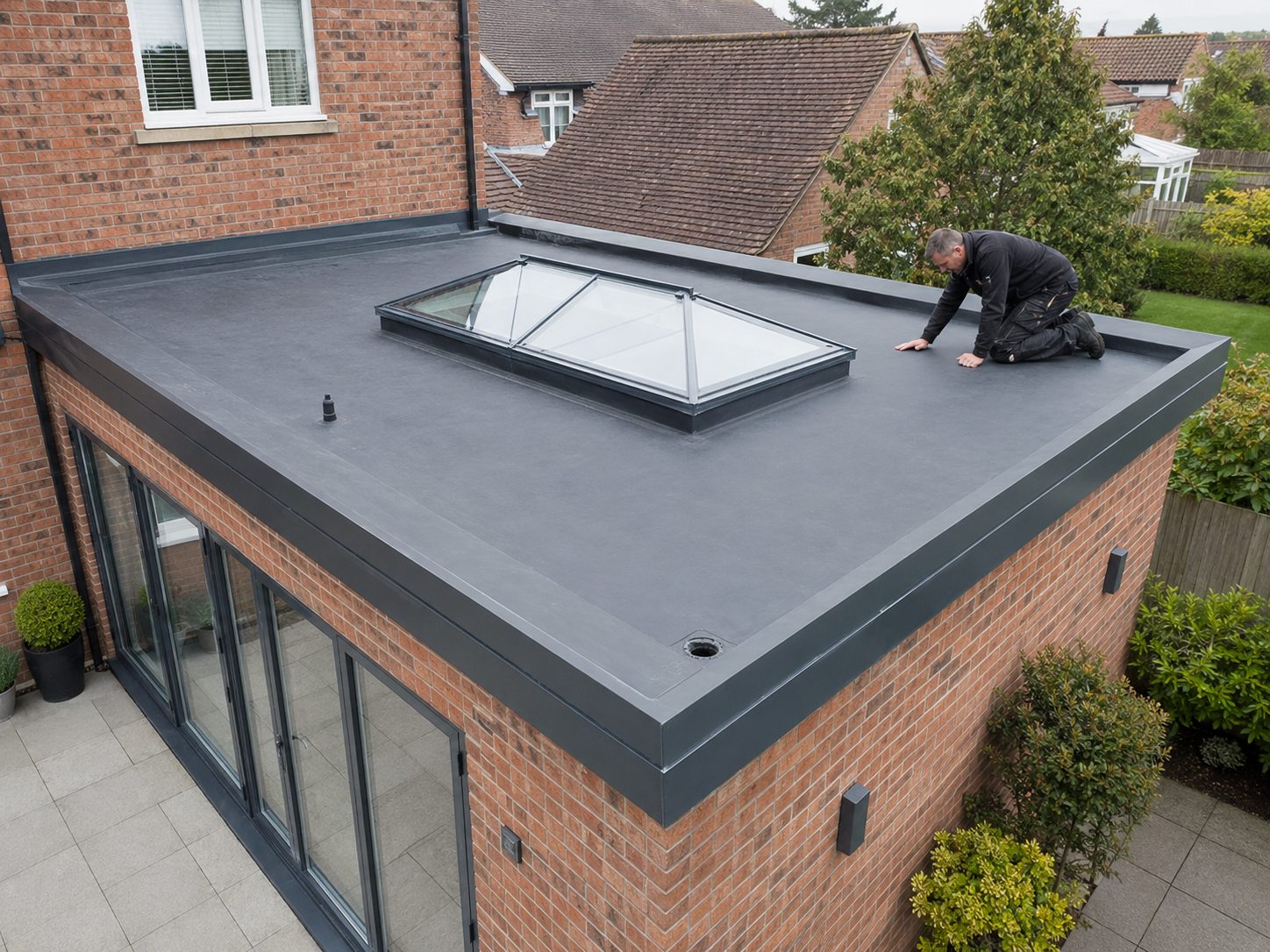
Garage roofs get almost no attention until they leak, which is exactly why they fail earlier than the house roof above them. They are usually the cheapest covering on the property, they were often built by a different trade at a different time, and nobody stands in a garage during a downpour to notice the early warning signs. The good news is that garage roofs are also the easiest and least disruptive roofs to put right, because access is low, the area is small and there is rarely any scaffolding needed.
Need this sorted?
Flat Roofing & EPDM from Larke's Roofs.
First work out what your garage roof actually is
Most detached and integral garages in this part of the country carry one of four things. Built up felt on a timber deck is the classic, usually three layer with a green mineral cap sheet. Corrugated asbestos cement sheeting is common on garages and outbuildings from the 1950s to the early 1980s. Corrugated steel or fibre cement replaced it later. A few have a concrete deck with a bitumen or liquid finish.
This matters because each fails differently and each has a different safe way of being dealt with. Asbestos cement in particular is not something to break up, drill or pressure wash, and identifying it before anyone climbs on it is important, both for safety and because it is fragile and will not carry weight.
Felt garage roofs: the usual suspects
On felt, water almost never comes in through the middle of the sheet. It comes in at the edges. The drip trim along the front, the upstand where the roof meets the house wall, the joint where two rolls overlap and the corners where the felt was folded rather than cut and welded are the places worth looking at first.
The second cause is standing water. Garage roofs were often laid with a nominal fall that has flattened as the joists relaxed, so water sits in a pond and sits there for days. Ponding does not itself make a hole, but it holds water on top of every weakness and turns a lap that would have been fine into a leak.
The third is age. Felt gives long warning. The mineral chippings wear off, the surface goes grey and hard, and it starts to craze like old paint. Once a felt roof has crazed across most of its area, patching one crack simply moves the leak to the next one.
- Trims lifted at the front edge after a windy winter
- Upstand at the house wall dressed too low or never re-pointed
- Laps opening where the bitumen has lost its flexibility
- Blisters that have been walked on and split
Flat Roofing & EPDM
- EPDM rubber roofs
- GRP fibreglass roofs
- Torch-on felt systems
Sheeted garage roofs: fixings, not sheets
Corrugated roofs leak at the fixings far more often than through the sheet. The old hook bolts and nails come with a washer that perishes, the hole enlarges as the sheet expands and contracts through thousands of hot and cold cycles, and eventually every fixing is a small funnel. On a steel sheet you can often see rust rings around each one.
The other weak point is the ridge and the end laps, especially where sheets have been cut short or where a translucent rooflight panel has gone brittle and cracked. Those panels have a much shorter life than the sheeting around them and often account for the entire leak.
Patch, recover or replace
A patch is the right answer when the covering is generally sound, the deck is firm and the leak is at one identifiable detail. Cut out, dry, rebuild the detail properly and it will hold for years.
Recovering, meaning a new covering over a prepared and repaired deck, is the right answer when the felt has reached the end of its life but the structure underneath is sound. On a typical single garage this is a short job with no scaffold, and it is the point at which it is worth asking about EPDM rubber or fibreglass rather than another layer of felt, since both outlast it.
A full replacement including the deck becomes necessary when the boards have been wet for years. Chipboard decking is the giveaway: once it has absorbed water it swells, loses its strength and never recovers. If the roof gives underfoot, no covering laid on top of it will last.
What you can do today to limit the damage
Move anything that matters away from the drip and put a container under it. Clear the gutter and outlet if you can reach them safely from the ground, because a garage roof holding water because its outlet is blocked will leak far faster than one that drains.
Do not climb onto a garage roof to look. Garage decks are light, often old, sometimes rotten, and a foot through a felt deck is a serious fall onto a concrete floor. Asbestos cement and old corrugated sheeting will not take a person's weight at all, and are the single most common cause of fatal falls through fragile roofs in the UK.
If water is running in rather than dripping, we do offer 24 hour emergency call out and the number is 07437 005301.
What it tends to cost
Garage roofs are one of the cheaper pieces of roofing work because the area is small and access is easy. A detail repair on a single garage is usually a low hundreds of pounds job. Recovering a single garage in a modern system typically runs into the low thousands depending on size, insulation, deck condition and whether the trims and the gutter are being renewed at the same time.
Since inspections and written quotations are free, the honest way to find out is to have someone look. We will tell you if a repair will do, and we will tell you if it will not.
Want it looked at? See our flat roof repairs and replacement across Norfolk.
Want a professional to handle it?
Common questions
Is it worth repairing a felt garage roof or should I just recover it?
If the felt is sound and the leak is at one detail, repair it. If the surface has gone grey and crazed across the whole roof, or there have already been two or three patches on it, recovering costs less over the next ten years than a run of repairs.
Can you fit a rubber roof over the existing felt?
Sometimes, if the existing covering is dry, firmly bonded and flat enough to take a new layer. Where the felt is wet or the deck has soaked up water, overlaying seals the moisture in, so the old covering has to come off.
My garage roof is asbestos cement. What now?
Leave it alone and do not drill, cut or pressure wash it. Asbestos cement sheeting is only a risk when it is disturbed, so it needs to be assessed and handled correctly rather than broken up. Tell us when you book the inspection so we can look at it properly.
Why does my garage roof only leak in certain weather?
Wind direction usually explains it. Driving rain pushes water sideways under a lifted trim or an open lap in a way that straight vertical rain never does, which is why a roof can be dry in a downpour and wet in a squall.
Do you work on garages as well as houses?
Yes. Garages, outbuildings, extensions and porches are ordinary flat roofing and roof repair work for us, and they are quoted the same way as anything else, with a free inspection first.
Related services
Covering Norwich and Norfolk.